Skip to content

The UK Savings Crisis


The Centre for Enterprise, Markets and Ethics (CEME) is pleased to announce the publication of The UK Savings Crisis: Rediscovering the Principle and Practice of Saving by Andrei Rogobete.

A PDF copy can be found here. The publication can also be purchased in paperback by contacting CEME’s offices via email at office@theceme.org


Steve Morris: Lost gurus of the 80s – Jan Carlzon (Part 1: Moments of Truth)


Jan Carlzon’s book Moments of Truth comes from the depths of the 1980s. It is both prophetic and deeply inspiring and as fresh and relevant now as it was when he wrote it.

Carlzon was the young and dynamic president and CEO of Scandinavian Airline Services (SAS). He faced an unenviable challenge with this part-state owned monolith.

The Oil Crisis of the mid 70s had meant that the aircraft business had stagnated, and SAS was heading towards a $20 million loss. It was assumed that Carlzon would take the tried and trusted route of simply cutting costs – cheese-slicer style (all departments make the same level of cuts). But he realised that this would simply weaken the company.

He formed a new management team that concentrated all their energies on taking SAS on a new, and seemingly risky, course. The objective was to make the airline operationally profitable even though the market couldn’t be improved. Carlzon and his team decided that they would not achieve short-term profitability by selling aeroplanes; instead they would concentrate on providing the very best service in the market and so increase their share of that stagnant overall market.  They decided to concentrate on becoming the best airline in the world for the frequent business traveller.

Carson admits this wasn’t a particularly new idea, but it did work. He decided to stop regarding expenses as an evil that should be minimised but instead looked at how to spend money wisely within the company to build on what he called moments of truth.

One of the projects was to cut bureaucracy and so they radically cut the number of reports that were written and concentrated on only the communications that mattered. In the end they focused the entire company from the executive suite to the most remote check-in desk, on customer service.  In 1983 survey by fortune magazine SAS was named airline of the year 1983.

The moments of truth idea is an interesting one. It says that there are numerous interactions between customers and staff and for any business it’s those key moments with regular customers that make or break loyalty. If the day to day interactions with staff is positive, if staff can fix problems on the spot, if they seem enthused and as-one with the vision of the organisation then hey-presto!

The message is as relevant now as it was then – perhaps even more so.  We like businesses that feel personal and we like to see employees who look like they’re switched on. When it’s not there we genuinely know.

Underpinning Carlzon’s ethos is a creed that he relays at the very front of his book. His four points are that everyone needs to know and feel that they are needed. Everyone wants to be treated as an individual. Giving someone the freedom to take responsibility releases resources that would otherwise remain concealed. An individual without information cannot take responsibility; an individual who is given information cannot help but take responsibility.

In Carlzon’s world, responsibility is entrusted to the frontline and middle managers turn away from being administrators and become facilitators of the great vision which was to put the customer at the centre of everything.

Coulson realised that as well as this ethos there needed to be structural changes in the business. Traditional westernised businesses tended to have a fixed and rigid structure; middle managers become simply the passers-on of orders and the administrators while the senior leaders made all the decisions and had all the answers. Carlzon decided to have a much flatter structure where the top executive becomes a true leader devoted to creating an environment in which employees can accept and execute their responsibilities with confidence and finesse.

I ran a business that did all the things that Carlzon recommended, and it flew, rather as his airline did. As we emerge from Covid what will businesses look like and what will be the new moments of truth?


Steve Morris is the Vicar of St Cuthbert’s, North Wembly, an entrepreneur, and the author of several publications for CEME and beyond including Enterprise and Entrepreneurship, and Lessons from Family Business, both available from the CEME office. He is married, with two children and has three cats. His latest writing, Our Precious Lives, dealing with the power of story-telling is available here.


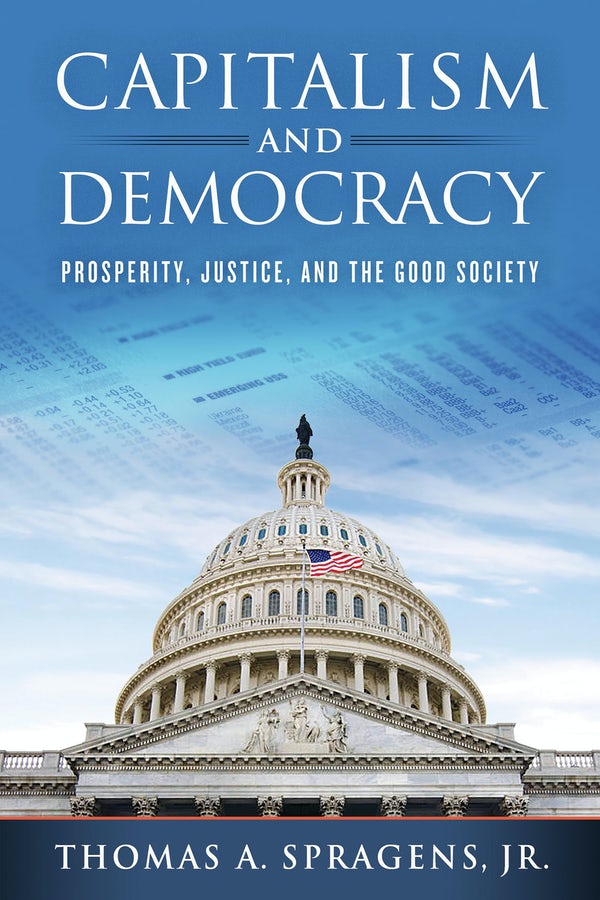
Richard Godden: “Capitalism and Democracy” by Thomas Spragens

Capitalism and Democracy is a short book and, as Tomas Spragens admits, it does not contain “a great deal of cutting-edge scholarship” (page vii). Nonetheless, it deserves to be widely read.

It comprises an explanation and analysis of “the sharp disagreement encountered these days between advocates of laissez-faire and champions of a more expansive welfare state” (page 10). Spragens suggests that, properly analysed, this debate involves disagreements in relation to three different issues: whether markets maximise prosperity; the moral defensibility of the distributions of resources produced by the capitalist marketplace; and whether the kind of society that free markets and minimal government produces would be a good place in which to live. Spragens analyses each of these issues in turn before attempting to draw some conclusions reflecting his own opinions.

Spragens states that his “general conviction is that reliance upon robust free markets as the principal mechanism for the allocation of a society’s economic efforts and resources is wise and proper” but goes on to say “I also believe … that governments need to regulate and supplement the distributive consequences of markets in a number of significant ways” (page 191). This view is apparent throughout the book and some readers will wish to challenge it whilst others will inevitably feel that their particular views or arguments are not accurately reflected. Nonetheless, Spragens has made a great effort fairly to present the opposing arguments in relation to each issue. He expressly disclaims having definitive answers to the issues at hand and, before expressing his own conclusions, explains why “those conclusions – and any of yours as well – have to be acknowledged as vulnerable to reasonable disagreement” (page 164). He is thus not trying to argue a specific case but rather “to narrow the geography of debate to a place where reasonable people may differ” (page 10).

In an age of political polarisation, this approach is refreshing, as is Spragens’ blunt reminder that “We cannot have it all” (page 185). However, it only takes the discussion so far. In the modern western world, the key issue is not whether there should be regulation, distribution and intervention by governments but how much regulation, distribution and intervention is necessary or desirable and Spragens has little to say about this. This points to what the book is and what it is not: it is intended to provide a framework for thinking rather than an analysis of contemporary problems and their potential solutions.

Spragens helpfully discusses what may be considered to be appropriate functions of government and suggests that “Our democratic debates … need to center on what the improvement and perfection of the mixed economy look like in concrete terms” (page 229) but he does not advance these debates (and, in the context of what he has said earlier in the book, his use of the term “perfection” may seem surprising!). Indeed, one is left with the uneasy feeling that he is broadly justifying the current balance between the laissez-faire and interventionist approaches that exists within the United States, subject to a few tweaks here and there. Essentially, his position appears to be similar to that adopted by Michael Greatz and Ian Shapiro in The Wolf at the Door (reviewed on our website) without the commendably specific proposals contained in their work.

The book is US-centric, but this is an issue to be borne in mind rather than a fundamental defect. Spragens is writing to a US audience and the arguments that he outlines and the things that he assumes reflect this. In relation to economic matters, the centre of gravity of US political debates is to the right of that in Europe. Hence, Spragens asserts that “few would challenge” the assumption that “enhancing wealth production is a good thing to seek” (page 69) whereas a European author might feel a need to defend such a proposition. Conversely, Spragens finds it necessary to explain some versions of laissez-fair philosophies that will seem extreme to European audiences. However, whilst this may result in those from Europe feeling that the book does not deal with some things that they would like to deal with, and deals with some things that they don’t consider to be relevant, it does not prevent the vast bulk of what is said being relevant to them.

Of course, it is possible to find fault with a number of things that Spragens says or does not say. Most of the issues in this respect are relatively minor but a few are more significant. For example, the book fails to analyse the distinction between society and the state and, more seriously, its discussion of the concept of “justice” lacks the precision of other parts of the book and is unsatisfactory. Spragens recognises the slipperiness of the concept and the problems in using it within the context of the laissez-faire versus intervention debate. He also draws attention to the serious problems in John Rawls’ much discussed concept of justice. However, he fails to identify clearly the major competing concepts of justice and thus to draw attention to one of the reasons that those discussing “economic justice” or “social justice” often talk past one another. From a UK Christian perspective, this is a pity because, in the UK, the concept of “social justice” is much talked about at the moment and many Christians discuss it as if their understanding of it incontrovertibly emerges from the Bible (particularly the Old Testament) without reflecting on their assumptions that underly that understanding.

Spragens seems to have sensed that there is something not entirely satisfactory about his treatment of these concepts because he returns to the subject in a four page postscript tagged on to his final chapter, which defends his “reticence to invoke social justice as an independent major basis” for the judgments and recommendations he has offered (page 230). He argues that it is “Impossible for anyone to claim convincingly that some specific distribution of resources would be entirely fair and just” having regard to the differences in people’s abilities, characters, upbringing and circumstances (page 230). He recognises that this might be seen as a counsel of despair or reflective of a lack of concern about unfairness but suggests that, in practice, for other reasons, much can be done and, indeed, is done to mitigate inequalities both at the level of government intervention and at a personal and community level.

Spragens says that he has two principal target audiences: the educated public who would like to improve their understanding of the proper role of the capitalist market place within a democratic society and college level students seeking an overview of issues that they will likely confront in economics, political science, moral philosophy and public policy courses. He may, however, have understated the range of people who will find the book of interest. At the very least, theology students should be added to the list of those who should read it and many others, who have previously thought about the issues, will benefit from a succinct overview of them.


“Capitalism and Democracy: Prosperity, Justice, and the Good Society” by Thomas A. Spragens, Jr was published in 2021 by Notre Dame Press (ISBN 978-0-268-20014-5). 234pp.


Richard Godden is a Lawyer and has been a Partner with Linklaters for over 25 years during which time he has advised on a wide range of transactions and issues in various parts of the world. 

Richard’s experience includes his time as Secretary at the UK Takeover Panel and a secondment to Linklaters’ Hong Kong office. He also served as Global Head of Client Sectors, responsible for Linklaters’ industry sector groups, and was a member of the Global Executive Committee.


CEME Event: “How Serious is the Return of Inflation?” – March, 2021

CEME was delighted to host a Zoom event on the highly topical issue of Inflation in the UK. Sir Robert Chote (Chairman of the Office for Budget Responsibility, 2010-20) participated alongside Lord Griffiths to the discussion. The full title of the event was “How Serious is the Return of Inflation?”, and took place on Thursday 18th March 2021.

This was a unique opportunity to hear two prominent economists debate a key moral issue in macroeconomics. Please find the full audio recording here.


Biographies:

Lord Griffiths taught at the LSE and City University and was Dean of the City University Business School. He was Head of the Prime Minister’s Policy Unit from 1985 to 1990. Lord Griffiths has been Vice Chairman of Goldman Sachs International, now an international adviser. He is Chair of the Board of the Centre for Enterprise, Markets and Ethics.

Sir Robert Chote, an economist, served as Chairman of the Office for Budget Responsibility from 2010 to 2020. Previously he has been Economics Editor of the Financial Times, adviser to the IMF and Director of the Institute for Fiscal Studies.


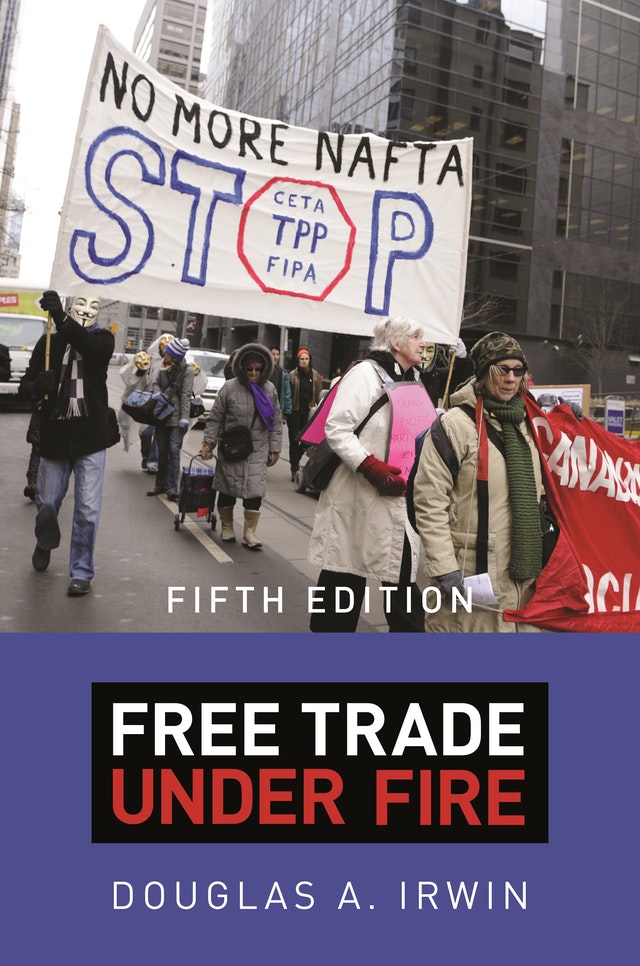
Andrei Rogobete: “Free Trade Under Fire – Fifth Edition” by Douglas A. Irwin


“Free Trade Under Fire” by Douglas A. Irwin is, as the title suggests, a book on the debate and defence of international trade. It covers a wide spectrum of (sometimes sensitive) issues on the subject. From national sovereignty and trade policies, to popular misconceptions about trade, the book tackles each argument with considerable depth and backed by evidence.

Douglas Irwin is John Sloan Dickey Third Century Professor in Social Sciences at Dartmouth College. He speaks regularly on trade policy (particularly U.S trade), and writes for various news outlets including the Wall Street Journal, New York Times, and Financial Times.

It perhaps comes as no surprise that the structure and language of the book is somewhat of a hybrid between the academic and ‘professional’ spheres. In parts it reads like a handbook for postgraduate students, while in others it is more opinionated and empirically driven. Regardless, each chapter is well written and considers the various angles of approaching the subject in question.

Therefore, one aim of the book is to “…introduce the reader to some basic economic principles and empirical evidence regarding international trade and trade policies” (page 8). It also seeks to address some of the misconceptions around trade in the “…modest hope that it may improve our understanding of the trade policy issues that confront us” (page 10).

The first and second chapters look at the position of the United States within international trade and evaluates the arguments for free trade. One of the first interesting points that the author makes is highlighting how the impact of international trade is rather blown out of proportion within US public discourse: over 85% of what is consumed in America is produced in America (page 26). Foreign imports therefore only account for less than 15%. Consumption spending is even higher with around 90% being spent on domestic goods (page 27).

A second interesting point emphasises how misguided our perception of the national economic impact of buying imported goods actually is, “…we sometimes exaggerate how much of the money goes to other countries. When you buy a $100 pair of Nike shoes, only $25 goes to the Asian factory that assembles them” (page 27). The rest of the $75 is spent in the US on design, shipping, insurance, and retail costs (ibid.).

Yet beyond these misconceptions surrounding international trade, the book’s most compelling argument in favour of trade liberalisation (based on Adam Smith’s Wealth of Nations), is the specialisation, division of labour and increased productivity that naturally occur under a free trade regime between nation-states. This results in economic gains for all parties involved.

The author uses individuals as an analogy to illustrate the benefits of trade, “Most people do not produce themselves even a fraction of the goods they consume. Rather, we earn an income by specialising in certain activities and then use our earnings to purchase various goods and services. […] Like individuals, countries benefit immensely from this division of labour and enjoy higher real incomes than they would by foregoing such trade” (page 36). This relatively simple but little-known fact is critical to understanding the benefits of free trade.

Chapters three and four turn the discussion to protectionism and the impact of free trade on jobs and wages. Here the book makes an important point that seeks to explain the paradox between the gains from free trade and the controversiality in the adoption and implementation of free trade policies.

The answer lies in successfully (if that is an adequate word here) managing the short- versus long-term beneficiaries of free trade. Not all industries are impacted the same, “…in the short-run, not everyone stands to benefit from the trade policy. […] Specific groups that benefit from protectionist barriers usually exert political influence beyond their numbers” (page 104). The bottom line is that protectionist measures “… provide large benefits to a small number of people and cause a very great number of consumers a slight loss” (ibid.). Reaping the benefits of free trade often requires time and this is perhaps one of the greatest challenges for set-term elected officials that often prefer policies with a much shorter time horizon.

The final chapters look at the international free-trade system itself and the current governing bodies (e.g. the World Trade Organisation). The book concludes with re-emphasising the importance of free trade and the economic benefit it bought to quite literally, billions of people around the world (page 322).

Yet free trade also remains a contentious issue because of partisan politics. Under President Trump, the US has in many ways inclined to a protectionist approach of trade that is more rooted in populism than theory. The danger is that, as the book points out, a weakened commitment from the US for free trade will lead other countries to follow suit, “…trade policy choices that the US makes have ramifications far beyond America’s shores…” (page 319).

In concluding, “Free Trade Under Fire” by Douglas A. Irwin is a well-written, well-researched, and timely piece of work. It is excellent reading for anyone with a remote interest in free trade. The book arises multiple remaining questions and challenges for the rest of us: How can the truth about free trade be presented in a so-called, “post-truth” society? How can our elected representatives be better equipped to argue in favour of free trade when the alternative is often simpler, clearer, and electorally more attractive? How do we explain to millions that feel left out of the system that they and their families only stand to gain from free trade in the long-run?

It seems therefore that free trade is currently facing a PR problem. It has been ousted in many places by seemingly sharper nationalist rhetoric. We need to be re-educated on the matter and “Free Trade Under Fire” by Douglas A. Irwin is an excellent step in that direction.


“Free Trade Under Fire – Fifth Edition” by Douglas A. Irwin was published in 2020 by Princeton University Press, (ISBN:9780691201009, 0691201005), 352pp.


Andrei E. Rogobete is the Associate Director of  the Centre for Enterprise, Markets & Ethics. For more information about Andrei please click here.


Online Event: The Social Licence for Financial Markets – February, 2021


CEME held an event on “The Social Licence for Financial Markets – Reaching for the End and Why it Counts”, which took place on Wednesday, 24th February 2021.

Financial markets depend on trust, including the trust of the society in which markets operate. Our main guest speaker was David Rouch followed by a response by Lord Griffiths of Fforestfach. David is an international financial services lawyer and, since 2004, a partner in Freshfields Bruckhaus Deringer. He is the author of The Social Licence for Financial Markets, published by Palgrave MacMillan in 2020.


The full audio transcript of of the talk can be found here.


Philip Booth: Subsidiarity Post-Covid


“[i]t is an injustice and at the same time a grave evil and disturbance of right order to assign to a greater and higher association what lesser and subordinate organizations can do.” (Quadragesimo anno, 79).


In the current crisis, there is much talk of “policy reset”. Some of that talk seems strange. We have the most centralised health service in the Western world and it has not obviously performed better than healthcare services in other countries. The NHS has also moved infected people out of hospitals and into care homes with disastrous consequences. Despite that, reliable sources in the UK government seem to be suggesting that, following the crisis, there will be a move to centralise political control of the NHS further and also that the NHS will take control of social care from local authorities.

Instead, there is a strong argument for policy moving in a decentralising direction. As with any tenet of Catholic social teaching, the principle of subsidiarity chimes with human nature. It ensures that responsibility is not given to remote bodies who cannot understand the details of the problems that they are trying to solve. It leaves individuals, the family, civil society institutions and local levels of government free to use their initiative to understand, take responsibility for and act to solve problems and to work with others to promote the common good and to discern and enact God’s plan for them. The principle of subsidiarity doesn’t just apply to political institutions. Local government should not do what civil society can do; the school exists to help the family in education their children not to take over their function; and so on.

It is notable how far the UK is from even beginning to apply the principle. The table below shows the proportion of taxes raised and government spending in a number of major countries in 2017 (data from OECD).

Table: Centralisation of government spending and taxation

Country Percentage of tax revenue raised at sub-national level (2017) Percentage of expenditure at sub-national level (2013) For comparison: percentage of expenditure at sub-national level 1890
UK 5 23 43
France 13 19 22
Italy 16 27 25
Japan 23
Germany 32 41
US 32 49 62
Canada 50 67


Two things are clear. The first is that, by any measure, the UK is a very centralised country. The second is that, when it comes to spending, the UK is not quite so centralised. In other words, local authorities effectively act as branch offices of Whitehall. They collect a little bit of tax, have some money handed to them and have to enact a staggering 1,300 statutory duties imposed on them by Whitehall.

The principle of subsidiarity not only requires that activities are undertaken at the lowest possible level but, where central government does act, it should do so by helping the lower levels of society in their task of promoting the common good. The opposite seems to be the case in Britain. The main function of the town hall, it would appear, is to assist Whitehall in the delivery of the latter’s agenda.

It could be very different. Indeed, as can be seen from the table, British political life was not always so centralised. In a country of 55 million (to take England alone), it surely cannot be the case that the right level to provide those things that government has to provide is central government level in almost every case. The human person is limited in cognition and knowledge. We need to be close to the problems that we are trying to solve in order to understand them properly. Such closeness is necessary for a genuinely human response. The right solution to a problem in Glasgow is unlikely to be the right solution to an apparently similar problem in St. Ives. The mix of government, private, mutual and civil society action that is necessary to promote the common good and provide common goods will be different in urban and rural areas and will differ between localities for all sorts of other reasons. Those regulations that might be necessary to restrain private activity (perhaps related to gambling, drinking or shop opening hours) will also be different in different parts of the country.

These all seem like secular, human problems rather than religious ones. However, the Catholic Church gives her guidance on issues such as subsidiarity because she is an expert in humanity. Subsidiarity chimes with human nature.

The “man in Whitehall knows best” attitude that pervades British public life is surely an offence against the virtues of prudence and humility. Given the clarity of Catholic social teaching on this issue and the extent to which the UK is an outlier, it is surprising that the Bishops of England and Wales have not drawn attention to the centralisation of British political life in the advice they provide before elections. At any rate, anybody believing that the government should follow the principles of Catholic social teaching cannot be satisfied with the current settlement in Britain.


This  was first published on the Catholic Social Thought blog.


Philip Booth is Senior Academic Fellow at the Institute of Economic Affairs and Professor of Finance, Public Policy and Ethics at St. Mary’s University, Twickenham. He also holds the position of (interim) Director of Catholic Mission at St. Mary’s having previously been Director of Research and Public Engagement. He is a Senior Research Fellow in the Centre for Federal Studies at the University of Kent and Adjunct Professor in the School of Law, University of Notre Dame, Australia. He is also an Associate Fellow with the Centre for Enterprise, Markets and Ethics (CEME).


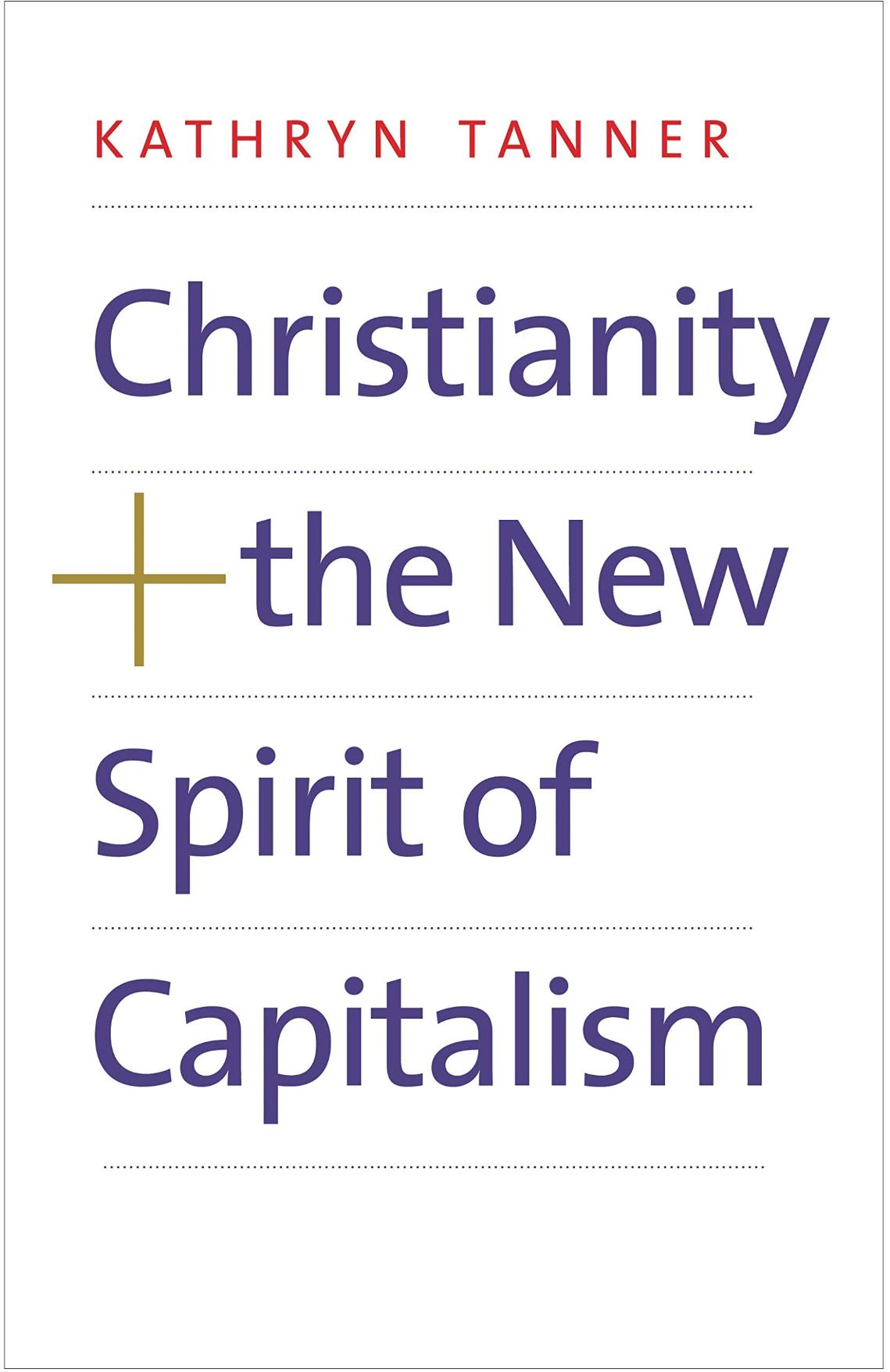
Richard Godden: “Christianity and the New Spirit of Capitalism” by Kathryn Tanner


Christianity and the New Spirit of Capitalism is, in one sense, inspired by Max Weber’s famous suggestion that Protestant Christian beliefs gave rise to a work ethic that provided the foundation of modern capitalism. Weber believed that the Protestant ethic produced what he called the “Spirit of Capitalism” and Kathryn Tanner agrees that “religious beliefs (Christian beliefs specifically) have the capacity to provide powerful psychological sanctions for economic behavior” (page 4). She also adopts the concept of the “Spirit of Capitalism” but her aim is far removed from that of Weber: she seeks “to show how Christian beliefs … might undermine rather than support the new spirit of capitalism” (page 7).

Tanner’s thesis is that capitalism is now finance-dominated and has cultural commitments that are at odds with Christianity. She thus wants “to provide a Protestant anti-work ethic” (page 30). With this objective in mind, each chapter of her book (other than the first) comprises a description of an aspect of what Tanner considers to be the spirit of “finance-dominated capitalism” followed by a contrasting description of what she considers to be the relevant Christian philosophy. She concludes by expressing the hope that she has “shown the coherence of a whole new world to be entertained as an imaginative counter to the whole world of capitalism as it presently exists” (page 219).

A number of Tanner’s criticisms of the extremes of some forms of capitalism would be widely accepted. For example, she criticises the demand for total commitment to paid work that leaves no time for reflection, the maximising of profit at the expense of everything else, the regarding of people as mere economic property, short termism in management and the devastating social consequences of personal debt among the poor. Furthermore, many Christians and other theists will agree with her starting point in relation to commitment, identity and value: “Commitment to God and the conversion that brings it about interfere with total commitment to anything else, thereby limiting the degree to which I could ever be completely personally invested in a company’s aims” (page 86); “the tasks one undertakes at work cannot be taken to exhaust one’s identity – and should not be pursued in any all-consuming fashion that would suggest as much” (page 98); and “What matters in the end is one’s relation with God, one’s value in God’s eyes and not one’s relative worth measured against others” (page 204). Put simply, capitalism cannot be accepted as an all embracing world view.

That said, however, Tanner’s thesis does not hold together. She states that her accounts of finance-dominated capitalism and its spirit “are offered as ideal types in a Weberian sense of that phrase: that is, they are analytical constructs that accentuate certain aspects of the messy reality of the current economic and cultural scene and show how they might be brought together into relationships with an internal consistency” (page 10). However, what she offers is a muddled caricature.

She fails to distinguish between situations that are fundamentally different: comments that could only relate to investment banks are mixed in with comments that appear to relate to industrial companies without the distinction being acknowledged; she fails to distinguish between the activities and motives of market-makers and other dealers, those of corporate users of the financial markets and those of long-term investors; and comments relating to people fail to identify the exact groups to which they relate, with the result that the problems faced by professionals, other white collar workers, skilled and unskilled workers are jumbled together as though they represented problems common to the mass of humanity exposed to modern capitalism.

Many of Tanner’s statements are absurdly extreme. She makes modern corporations sound like Maoist states, commenting that “Workers themselves are to want nothing more than what corporations ask of them; their own desires are to be brought into complete compliance with finance-dominated corporate interests” (page 64) and “Workers are to be encouraged to want for themselves what the company wants from them” (page 70). It seems that corporations can do nothing right in her eyes: she laments the pushing down of responsibility for decision making, continual assessment, the use of relative rather than absolute measures of performance, the need for workers to perform increasingly complex tasks and even multi-skilling!

Her criticisms of the financial markets are similarly exaggerated. She recognises that derivatives may be a form of insurance and, on occasions, makes comments that suggest that she may have an inkling that the reality is more complex than her thesis suggests. However, she spends many pages asserting, essentially, that the financial markets are divorced from underlying economic reality and that they offer “promises of a defanged future” that “turn out to be spurious” (page 156).

Tanner is also critical of governments suggesting that they too have become finance-dominated and are reneging on “previously accepted obligations to guarantee the welfare of the population, through medical or unemployment benefits, for instance” (page 22). However, the bogeymen in relation to this are clear: she says that “government policy can easily be taken hostage by foreign investors and the increasingly few rich among its own citizens with the ability to make significant purchases of government bonds” (page 23). Absurdly, she asserts that “Only efficiently run governments, which means governments run like finance-dominated corporations so as to cut costs to the bone, are deemed credit-worthy on the open market” (page 48). If this were true then the majority of governments around the world would find it impossible to secure finance!

Many Christians will take issue with Tanner’s theology. Some aspects of this are peripheral to her thesis. However, her theology of work is central to that thesis and is highly contentious. She asserts that “there is surprisingly little reason to think Christianity has a direct interest in developing a work ethic at all” (page 198) and she rejects the idea of secular vocation (i.e. the view that “one can serve God directly in economic pursuits because those are thought to be themselves divine vocations, part of God’s specific plans for one’s life”, page 200). Unfortunately, once again, she caricatures the view that she is criticising and never engages properly with the arguments in its favour. She asserts that “The problem with direct assignment of religious value to economic pursuits is that it provides religious sanction for whatever form of employment society happens to saddle one with, no matter how limiting or degrading” (page 201), which is blatantly untrue of most forms of the Protestant work ethic. She then justifies her “anti-work ethic” on the basis that one’s individual worth comes from God and not from comparison with other people, which is true but beside the point.

She never engages with the statements of Jesus and St. Paul and other biblical writers that appear to ascribe real value to secular work (e.g. “Whatever you do, work at it with all your heart, as working for the Lord, not human masters”, Colossians 3:23, NIV). She also asserts that “God…does not create and save people for the sake of some objective they are tasked with pursuing” (page 206) without engaging properly with parts of the Bible that appear to assert that part of the objective of creation and redemption is productive work. She says that “there was no need for extreme effort in Eden before the disordering of the world as God intended it” (page 207) and appears to believe that she has thereby demonstrated that those who appeal to the Genesis account in support of the Protestant work ethic are wrong. However, the inclusion of the word “extreme” results in her attacking an Aunt Sally. She does not deal with the fact that the Bible indicates that, prior to the Fall, God intended people to work (Genesis 2:16) or the fact that we live in a fallen world.

Even those who accept Tanner’s basic thesis are likely to find the book unsatisfactory since it lacks suggestions as to what Christians should do about the mismatch between the spirit of modern capitalism and that of Christianity. Bizarrely, the only specific practical suggestion in the whole book is that employers should make “no-interest advances on worker’s paychecks in a routine fashion … rather than leaving them with high-interest payday loans as their only option” (page 128), a suggestion that misses the point that such advances would simply bring forward the monthly payday without solving the financial problems of employees that result in the recourse to payday debt.

Tanner may object that her purpose is merely to encourage Christians (and, perhaps, others) to adopt an ethic that it is at odds with what she perceives to be the spirit of modern capitalism. She says that she is suggesting “that the financial approach to the future is part of the present world to be left behind, a world to be repudiated in all the very basic ways it counsels people to relate to themselves and others, in favour of a whole new world to come that will be as different from this world as possible” (page 166). This is fine sounding but it is hard to see how it will help anyone decide how to behave in relation to their everyday work. If one accepts her rejection of the view that secular work can be a calling, one has to determine the role that it should play in one’s life and the relationship between it and other aspects of life.  Furthermore, if one wishes to have an influence on companies and governments, then one needs to have some specific policy suggestions to offer.

Those looking for help in relation to these things would be better off reading some of the other books reviewed in the section of this website entitled “The Business World” (see, in particular, those mentioned under “The Purpose of Business”).


“Christianity and the New Spirit of Capitalism” by Kathryn Tanner was published in 2019 by Yale University Press (ISBN 9780300219036). 219pp, plus notes.


Richard Godden is a Lawyer and has been a Partner with Linklaters for over 25 years during which time he has advised on a wide range of transactions and issues in various parts of the world. 

Richard’s experience includes his time as Secretary at the UK Takeover Panel and a secondment to Linklaters’ Hong Kong office. He also served as Global Head of Client Sectors, responsible for Linklaters’ industry sector groups, and was a member of the Global Executive Committee.

Steve Morris: The Homespun Wisdom of Robert K Greenleaf

Steve Morris continues his series on lost management gurus

It is 1969 and campuses in the US are alive with revolt and turmoil. The anti-Vietnam protests are getting serious and America looks like it might fracture. It was time for a little-known educator, born in 1904 in Terre Haute, Indiana, to propose a way of succeeding without trampling on each other. His name was Robert K Greenleaf.

Greenleaf was no academic star. He graduated with a modest maths major in 1926 from Carleton College in Minnesota. Indeed, he was always sceptical that simple academic prowess was enough to really change anything. Greenleaf joined US telecoms giant AT&T and over the years rose steadily and had a major impact on that business. He acted as a troubleshooter and educator. It was during this period that he had a breakthrough: that the organisations that really succeeded tended to have good management but of a specific kind. In these organisations, leaders were coaches not tyrants. As he put it: “The organisation exists for the person as much as the person exists for the organization.”

This was certainly not a popular view at the time and still looks like the world seen upside-down. Greenleaf’s road to Damascus moment was reading an obscure novella by German writer Hermann Hesse – The Journey East. It is a truly odd little book, I know because I’ve read it, and pictures a strange mystical journey by a bunch of seekers. They are backed up by a person called Leo who serves the team selflessly. He is easy to miss, but when he suddenly leaves, the mission collapses. It seems that the humble servant was, in fact, the leader.

Greenleaf took this insight and produced his seminal essay The Servant as Leader in 1970. In it, he proposed that the best leaders were servants first, and the key tools for a servant-leader included listening, persuasion, access to intuition and foresight and use of language. As he put it, “The servant-leader is servant first… It begins with the natural feeling that one wants to serve, to serve first.” And in this, we begin to see the slightly fuzzy edges that make the idea hard to pin down. The question arises, are you born with this instinct and what happens if you aren’t?

Over time, Greenleaf expanded on his idea and a fuller picture of the servant leader emerged. A Servant Leader shares power, puts the needs of the employees first and helps people develop and perform as highly as possible.

It is deeply challenging, because it takes issue with the corporate mentality that says always put the customer first. What if the needs and development of those who work for you have at least an equal call on your good offices?

Greenleaf came up with a useful test to measure how well an organisation is doing. Have you got things round the right way?

“Do those served grow as persons? Do they, while being served, become healthier, wiser, freer, more autonomous, more likely themselves to become servants?”

Greenleaf retired from AT&T and made servant leadership his life’s work. It still has devotees and it is hard not to feel warm to the idea. Greenleaf became a Quaker in later life and his ideas certainly owe a great deal to Judeo-Christian ideas. Indeed, Greenleaf frequently quotes the Bible and the actions of Jesus.

So why is it that I feel a little unconvinced? It is in part, my uneasiness with anyone taking on the role of prophet and guru. I find myself asking, ‘Who says?’ Why have you alone suddenly worked all this out? I simply mistrust people who seem to have cracked it.

Also, does servant leadership give us the full picture. Are there times when directional leadership is called for? Are there times and situations where we simply have to get on with things even if we don’t grow or thrive? Are there places where it is most likely to work. Perhaps servant leadership may thrive in places where there is no promotion to be scrambled for, or where people come into leadership later in life and don’t aim to climb the greasy pole, as Disraeli put it.

I ask the people around me what they think and if they have ever had one of these servant leaders. Rather sadly, perhaps, none of them can think of anyone.


Steve Morris is the Vicar of St Cuthbert’s, North Wembley, an entrepreneur, and the author of several publications for CEME and beyond including Enterprise and Entrepreneurship, and Lessons from Family Business, both available from the CEME office. He is married, with two children and has three cats. His latest writing, Our Precious Lives, dealing with the power of story-telling is available here.


Anne Devlin: “The Social Dilemma” by Jeff Orlowski

This documentary is structured around interviews of tech experts who were pioneers at leading social media platforms and who came to realise that something important went wrong at some point. These views are expressed through a fictitious drama showing the impact of social media on the different members of a family. It is easily accessible to non-social media aficionados and articulates issues that most of us have intuitively perceived without being able to find the common thread running through them.

This Netflix documentary opens on a sombre note with an ominous quote from Sophocles, “nothing vast enters the life of mortals without a curse”, which is somewhat disconcerting. Unlike Greek tragedies, The Social Dilemma finishes on a carefully hopeful note whereby with greater awareness of the problem and willingness to discuss the issues, it can be fixed. But what exactly is the problem?

The realisation that the tech industry lost its way, making no room for ethical design or even questioning the moral implications, is clearly linked to the monetisation of the social media platforms. Their business model is unveiled and brought back to its essence: if you’re not paying for the product then you are the product. As Jaron Lanier, the American computer philosophy writer, puts it: “It is the gradual, slight, imperceptible change in your own behaviour and perception that is the product.” And the more you are using the platform, the more data feeds the system and therefore the better the prediction of your action. The picture starts getting really scary when you realise that cognitive psychology, especially how to persuade people, is built into the technology itself, deliberately exploiting vulnerability in human psychology. Tristan Harris puts it powerfully when he highlights that people usually recognise the danger when technology will overwhelm the human intelligence. An earlier moment is, however, perhaps more dangerous, namely when technology overwhelms human weaknesses, overpowering human nature and breeding among other things addiction, polarisation, and radicalisation.

Algorithms are originally programmed to a certain definition of success. If it is to maximise revenue, computer learning will improve and optimise towards that goal with no ethical constraints or concerns. Maximising engagement, growth and advertising targets will make algorithms ruthlessly manipulate our emotions and behaviours without us even being aware of it. As fake news travels six times faster on Twitter than the truth, the system has a bias towards disinformation as it makes more money for the company. A systematically individually customised information flow, designed by algorithms to maximise your engagement or watch time, sows division in society: people cannot hear a different opinion since they are being fed the one side of the story which their profile establishes they want to hear. Polarisation, going down rabbit holes, conspiracy theories, and radicalisation are all common manifestations of technology’s ability to destabilise the fabric of society. While we witness a technology-led assault on democracy, we should also worry about the use of technology by totalitarian regimes.

To conclude, this documentary highlights the fundamental issue that systems of algorithms are void of ethical consideration. Their ultimate goal is to maximise profit. AI cannot know what Truth is but people need to have a common perception of reality in order to live together. The positive note comes from the realisation by the tech experts, spearheaded by Tristan Harris, that they do have a moral responsibility to fix it. That starts with a conversation about what the problem is, which is exactly what this documentary succinctly achieves. It will be a difficult journey since any reform of the system will chart a collision course with the current business model of the powerful social media giants. Technology is a great force for good, but the moral dilemmas raised by the social media platforms need to be addressed transparently.


The Social Dilemma is directed by Jeff Orlowski and was first released on Netflix on 9th September 2020.


Anne Devlin is a director of Terra Solar II, a former oil trader with BP and a member of the Board of CEME.


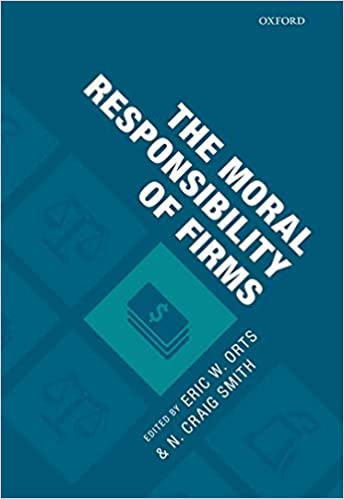
Richard Godden: “The Moral Responsibility of Firms” By Eric Orts and N. Craig Smith

Are corporations and other business organisations morally responsible for their acts and omissions? The media and popular discourse frequently assume that they are: companies are sometimes said to have “behaved disgracefully” and, in response, they “apologise”; legislators and regulators around the world seek to impose penalties on companies and justify this by reference to their alleged responsibility for wrongdoing.

But is the attribution of moral responsibility justified? Should we regard such attributions as either misconceived or merely a shorthand way of attributing responsibility to individuals within the relevant organisation? Or can one, in some sense, say that an organisation is morally responsible for its actions and, if so, with what consequences? It is these questions that The Moral Responsibility of Firms addresses.

The book originates in a 2013 conference sponsored by the Warton School of the University of Pennsylvania and INSEAD. It comprises essays by twelve authors sandwiched by contributions from the two editors. The authors comprise a distinguished array of academics from a variety of disciplines (ethics, philosophy, law, business and politics) and the editors line them up in three groups: four essays (by a total of five authors) set forth the arguments in favour of attributing moral responsibility; four (again having five authors) set forth the arguments against; and, finally, two (each with a single author) seek to point a way forward for the debate.

All the essays are of a high standard and, although they comprise serious academic work, their arguments are accessible to any educated reader who is prepared to take the time to study them carefully. Some of the authors could have used less dense language (Michael Bratman being a particular offender is this respect) and some (e.g. Philip Pettit) unhelpfully cross refer to their previous work in order to save space but these failings do not act as a serious barrier to comprehension.

Readers may find the US bias of the authors frustrating but, although a few of the issues discussed are very US specific (e.g. the question corporations are persons entitled to benefit from rights under the US constitution), these discussions are brief and the vast majority of the book is devoted to issues that are applicable to the situations in other countries. Furthermore, the authors make good use of recent corporate history to illustrate the points that they are making and the events that they refer to are generally widely known outside the USA (e.g. the Deepwater Horizon explosion and oil spill that cost BP Plc a huge amount of money and the Herald of Free Enterprise disaster).

There are two basic approaches to the attribution of moral responsibility. The first, a metaphysical approach, is adopted by Pettit. He argues that corporations (and, indeed, many other organisations and human groups) are “conversable agents”, by which he means that “in normal unrigged circumstances [a corporation] maintains certain purposes, forms reliable representations of its environment, and acts reliably so as to satisfy its purposes according to those representations” (page 17) and “corporations can use words as the means of forming their purposes and representations” (page 19). In short, he suggests that corporations are analogous to human beings in relation to the things that he considers matter for the attribution of moral responsibility.

Bratman and Peter French agree with this. Bratman argues that a group may be held responsible for its actions even in circumstances which there is no shared intention among members of the group, whilst French suggests that the moral responsibility of an organisation may vary over time as its composition and “self-told narrative” changes.

In contrast, Waheed Hussain and Joakim Sandberg arrive at the attribution of moral responsibility by means of what they call “normative functionalism” rather than metaphysics. They expressly reject “pre-institutional” corporate moral agency (i.e. Pettit’s approach, page 66) and argue in favour of attribution of moral responsibility by asking “what forms of treatment for business corporations would serve the justifying aims of the competitive market” (page 67). Pursuing this pragmatic, positivist view of moral responsibility, they suggest that “issues about when and how to treat groups of individuals as collective agents are best understood as interpretative questions about specific social practices” (page 75). Hence, “there is no one right way to treat a group of individuals as a collective agent: different forms of treatment are appropriate in different domains and contexts” (page 76).

The authors who oppose the attribution of moral responsibility also display a diversity of approaches. For example, John Hasnas is prepared to assume that Pettit has established that corporations can be held morally responsible and he thus focuses on whether they should be, but others are less reticent. David Rönnegard and Manuel Velasquez confront Pettit’s arguments head on; Amy Sepinwall argues that blame is only appropriate in relation to those who can feel guilt and experience punishment, which a corporation cannot; and Ian Maitland trenchantly says, “I have carefully avoided entering the debate over the metaphysical or ontological status of the corporation or other collective actors. That way lies madness” (page 119).

Nonetheless, there are common themes that emerge from the essays of those in the “anti” camp. Maitland speaks for them all when he says that “the anthropomorphization of the corporation has become a source of mischief, manipulation, or abuse” (page 106) and they share a strong belief that the responsibility deficit that Pettit fears would exist if corporations were not held to be morally responsible is illusory. It is, to use Hasnas’s term, a “phantom menace” (page 94). Having examined Pettit’s arguments, Hasnas suggests that they would only hold good if the inability to assign moral responsibility to corporations precluded the assignment of any kind of responsibility. This, he points out, is patently not the case since “Moral responsibility is not a pre-requisite for the assignment of civil, administrative, or ‘metaphorical’ responsibility” (page 95).

Underlying this is a wider issue: some of the authors (e.g. Hussain and Sandberg) use the terms “moral responsibility” or “responsibility” remarkably loosely. They sometimes appear to drift into confusing legal responsibility for moral responsibility and, within the category of legal responsibility, fail to distinguish between different kinds of liability (e.g. strict, “no blame” liability versus liability based upon attributed blame and criminal versus civil liability).

These confusions disguise the fact that the authors who favour the attribution of moral responsibility fail to explain exactly what they believe the practical consequences of that attribution would be. Hasnas recognises this issue and suggests that the only practical implication would be the attribution of criminal liability. However, even this concedes too much: there is no reason why moral responsibility and criminal responsibility should be linked in this way. The criminal law does not view moral responsibility as being a necessary requirement for the imposition of liability (c.f. strict liability offences such as many motoring offences) and, in any event, the moral responsibility of an individual may be, and sometimes is, attributed to a corporation for the purposes of criminal law (c.f. the English law of fraud). It is, in fact, difficult to see that there is any practical outcome for which the imposition of moral responsibility on corporations is either a necessary or a sufficient pre-condition.

The book is not without failings. In particular, the final two chapters (by Kendy Hess and Nien-Hê Hsieh) are disappointing. They are presented as an attempt to synthesize the points made by others, to demonstrate a substantial measure of agreement between the two opposing positions and to point a way forward for the debate. However, both authors are proponents of ascribing moral responsibility to corporations and their reasoning comes across as an attempt to demonstrate that those who are against such ascription are actually in favour of it after all! For example, Hsieh states that what emerges in his discussion of the issues is “that by assuming business firms are moral agents” one can “sidestep long-standing debates about the purpose of the for-profit business firm” (page 190). Hsieh recognises the obvious problem with this, namely that it assumes moral agency, which is precisely the point at issue. However, his attempt to break out of the circle through redefining the purpose of corporations is unconvincing. Perhaps no synthesis of the opposing arguments is possible.

More seriously, taken as a whole, the essays suffer from a glaring omission: all of the authors appear expressly or impliedly to view morality as a human construct and none of the essays examines this assumption. Christians and other monotheists will take issue with this. If a personal God exists, then moral responsibility is ultimately to do with a person’s relationship with that God: to say that someone is “morally responsible” is to say that they are accountable to God in relation to their behaviour. On this basis, a corporation cannot be morally responsible. It may be legally responsible but being (at most) a human legal creation, it cannot in any meaningful sense be accountable to God.

Hence, monotheists must surely reject the metaphysical concepts of Pettit, Bratman and French and  also Hussain and Sandberg’s normative functionalism as an account of moral responsibility: if God is the source of moral responsibility then Orts’ argument that moral responsibility should be imposed on a firm “if only for pragmatic reasons” (page 218) must be rejected.

Monotheists may nonetheless agree that some of what Hussain and Sandberg say is a useful guide to the circumstances in which society might decide to impose legal responsibility on corporations. Hasnas’s insistence on a careful distinction between different kinds of responsibilities is thus crucial. However, before leaping to the conclusion that even legal responsibility should be imposed, it is essential to take account of the danger, highlighted by Hasnas, Maitland and Sepinwall, that one ends up punishing the wrong people and also to face the possibility that our desire to ascribe moral responsibility to corporations is simply a manifestation of our desire to blame someone whenever anything goes wrong.

Shareholders and, potentially, employees of corporations indirectly suffer as a result of the actions taken by regulators and law enforcement agencies on account of wrongdoing on the part of the managers of the relevant corporations. Hasnas, with pardonable exaggeration, describes this consequence as “antithetical to the fundamental tenets of liberalism” (page 94); Rönnegard and Velasquez rightly refer to the collapse of Andersen following the Enron scandal as an example of the issue, noting that tens of thousands of partners and employees suffered as a result of the indictment of Andersen on account of a few individuals; and Maitland is scathing about the modern tendency of law enforcement agencies in the USA to seek deferred prosecution agreements with corporations rather than pursuing the individuals within those corporations who have been responsible for the relevant wrongdoing (a tendency that is also manifest in the UK and elsewhere in the world), suggesting that this effectively allows those who are really to blame for a problem to use the company’s money to avoid personal responsibility. He reminds the reader of Professor John Coffee’s pithy characterisation of this as a “de facto sale of indulgencies” (page 110).

Hussain and Sandberg counter this by suggesting that imposing penalties on someone may be justified as “an incentive for them to act in a supervisory capacity”. This is true but it follows that such penalties need to be restricted to punishing the failure to exercise supervision and, clearly, should not be imposed on people who have no power to exercise it (as is the case with many shareholders and employees associated with particular corporations).

These points demonstrate the enormous breadth of the issues associated with the attribution of responsibility to corporations. The public debate about this is bedevilled by muddled thinking and ill thought through emotional responses. The Moral Responsibility of Firms is an important and high quality contribution to this debate. It deserves to be widely read.


“The Moral Responsibility of Firms” edited by Eric W. Orts and N. Craig Smith was published in 2017 by Oxford University Press (ISNB 978-0-19-885705-1). 223pp.


Richard Godden is a Lawyer and has been a Partner with Linklaters for over 25 years during which time he has advised on a wide range of transactions and issues in various parts of the world. 

Richard’s experience includes his time as Secretary at the UK Takeover Panel and a secondment to Linklaters’ Hong Kong office. He also served as Global Head of Client Sectors, responsible for Linklaters’ industry sector groups, and was a member of the Global Executive Committee.