
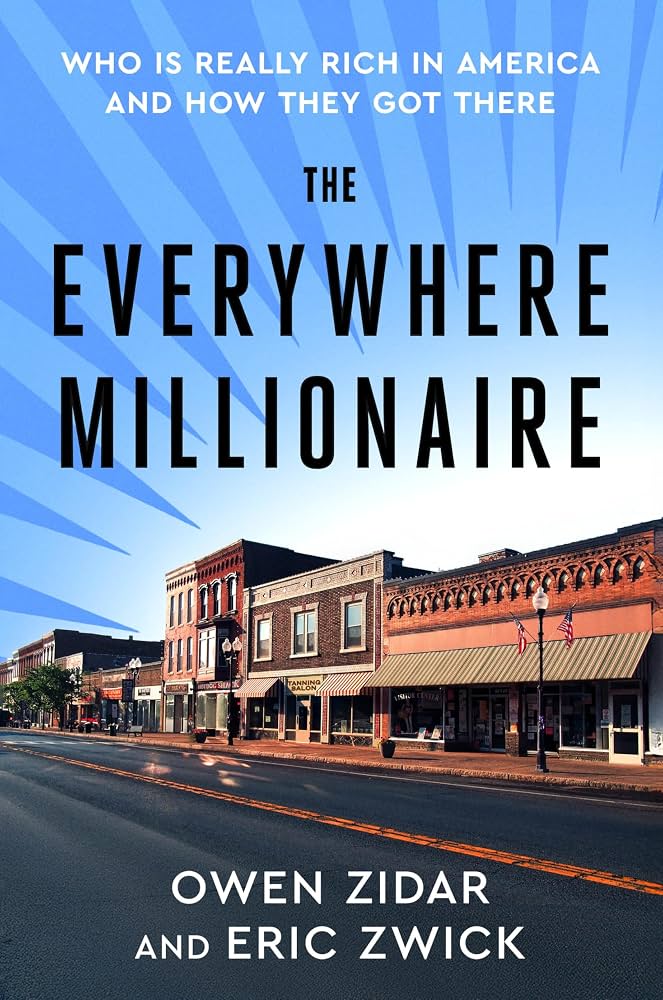
Economists Owen Zidar and Eric Zwick have made a great contribution to our understanding of wealth and social mobility in the USA with a new dataset shining a light on the ‘Main Street Millionaires’: a population rarely discussed but vital to an understanding of modern America and the long-term yield of Reagan-era supply-side reforms. For fans of freedom and capitalism their evidence is exhilarating. A book using the same evidence could be titled: The American Dream Is Alive and Well. Rejoice! It is a puzzle that they fall short of celebrating the success and instead fall prey instead to the usual disappointing platitudes about wealth, rising inequality and power politics, citing that business owners hold congressional seats at roughly ten times their share of the population, and their policy influence tends to fly under the radar because they are less visible than tech billionaires or Wall Street executives. They add that substantial tax and regulatory benefits flow to private business owners and are rarely debated publicly, partly because most people don’t realise how large this group is. Now they will.
Zidar and Zwick identify roughly 3m American private-business owners worth more than $5m, with mean wealth of around $25m. It is tempting to assume Musk, Bezos and the other billionaires are dragging the average up. In fact, by the authors’ analysis, this group collectively holds more than 13 times the wealth of the 400 richest Americans, the billionaires listed in the Forbes 400. The interesting new finding is the thickness of the ranks beneath the billionaire tail. That in itself is enough to commend the authors and their work as a major contribution.
Rich in Examples
These people are also everywhere. Our mental map of American wealth is too often coastal: Manhattan hedge funds, Palo Alto founders, Beverly Hills entertainment money. Zidar and Zwick find a substantial car dealer, HVAC magnate or franchise owner in virtually every congressional district, many in what coastal Americans condescendingly call ‘flyover country’, making fortunes from gutters, toilet-paper distribution, hamburger buns, urinal cakes and waxing salons.
The book opens with the Brockway family, whose fortune came from Florida car dealerships. Their daughter’s 2023 wedding reportedly cost about $60m and lasted five days in Paris. Guests flew in by private jet, Versailles was hired for a party, the Paris Opera hosted the rehearsal dinner, there were fireworks by the Eiffel Tower and Adam Levine performed. To snobby English tastes, their consumption and lifestyles can be gauche, though this reviewer, a committed Americanophile, delights in their unapologetic enjoyment of their just rewards, and regrets missing an invitation.
Many such case studies bring the phenomenon to life. My favourite may be Nancy Mueller, who began making quiches for parties in California and kept going until Nancy’s Specialty Foods was the world’s largest frozen-quiche producer; after selling it she commissioned a super-yacht and sailed around the world. Ex-Marine Dick Portillo began with a hot-dog stand in 1963, despite by his own account not knowing how to cook a hot dog, sold the business for around $1bn and acquired a 130-foot yacht called, inevitably, Top Dog. It reminds me of the thrill, as a young Goldman Sachs banker newly arrived in Manhattan from the UK, when I saw the yacht ‘EBITDA’.
All this is loud and occasionally tasteless. It is also evidence that America manufactures capitalists on a scale few of us understood, which deserves celebrating before it is processed into another seminar about inequality and taste.
There is a great achievement here in putting together the data. Working inside the US Treasury, Zidar, Zwick and their collaborators joined up tax records on businesses, owners and workers that had sat in separate parts of the system, a painstaking exercise which required a visit to a retired systems engineer in Utah to understand the coding of various archaic US government databases.
Context
For a British reader, the book’s references to S corporations and pass-through businesses need translation. Income passes through the entity and the tax is payable by its owners, an idea familiar to anyone who, like me, has spent years as an LLP member. What surprised me was the scale: roughly 95% of American businesses are pass-throughs of some form, while Britain’s 51,000 LLPs are estimated to be under 1% of the Companies House register.
The context for this is Reagan’s 1986 Tax Reform Act, which moved the top personal rate significantly below the corporate one, incentivising businesses to operate through tax-transparent pass-through entities. S corporation filings rose 36.5% in 1987 alone, and pass-throughs went from 20.7% of American business income in 1980 to 54.2% by 2011. The research cannot establish causality. But policies compound, and Reagan’s reforms are a plausible part of why so many wealthy proprietors now live inside that architecture.
‘The Rich’ Who Start Small
The nature of this wealthy population and the source of their spoils sit awkwardly with the celebrated Piketty rentier-class critique of modern extractive capitalism. Admittedly, around 70 cents of every dollar of pass-through income accrues to the top 1%, consistent with the familiar power law of distribution. Yet these top profits cluster not among the heirs of a gilded age but among working-age owners of mid-sized, closely held firms.
That is recognisable to me after decades in private equity. Few of the hundreds of entrepreneurs and business owners I have met resemble the caricature of ‘the rich’, and their businesses are frequently heroically dull: industrial distribution, vertical software, niche clinics, specialist manufacturing. A founder spends 20 or 30 years learning an industry, surviving recessions and reinvesting cash until five employees become 500. A plumber earns an income; someone who employs 200 plumbers owns an asset. Somewhere along the way the entrepreneur becomes one of ‘the wealthy’. What is striking is that, in contrast to the vogueish Silicon Valley mantra of ‘Move Fast and Break Things’, these lifelong builders have followed a humbler logic: move slow and make things.
In a previous (2019) assessment of another financially very successful group, Daniel Markovits’s The Meritocracy Trap described an elite trained through expensive schools, selective universities and the uber-demanding professions, and an unending, accelerating treadmill of elite performance from childhood to late career, with all its associated performance anxiety.
By comparison, the owner of the world’s largest frozen-quiche company may have accumulated rather less cultural capital than a Yale professor or McKinsey partner, but she ended up owning rather more yacht.
The book’s mobility data should also make some parents think twice when insisting on another maths tutoring session for little Jonny, and planting dreams of Big Law in a ten-year-old Mary. Of Americans born between 1980 and 1982 who rose from the bottom fifth of the income distribution to the top fifth, 9% became business owners, nearly three times the 3.7% rate for their whole cohort; only 1.3% of them attended an Ivy Plus college, barely above the 0.9% for the cohort as a whole. And the top tenth of test scorers become founders only 1.3 times as often as those at the median.
Rent-Seeking and the Creation of Wealth
Which brings me to the book’s final section. Zidar and Zwick document some real rent-seeking, from car dealers’ franchise protections to the regulatory privileges of alcohol distributors. None of this should trouble a serious defender of capitalism; Adam Smith knew perfectly well that businessmen can and do conspire against the public. He also knew that, as in those two examples, the state is often bound up in their conspiracy against the public. What matters is the distinction between wealth created through competition and wealth maintained by suppressing it, and the authors’ own evidence suggests much American wealth is of the first kind.
Success Deplored
However, the authors sadly decline to celebrate the success story their data has revealed. They are tempted by the too familiar political syllogism: high inequality is undesirable; successful entrepreneurs increase inequality; their success therefore contributes to an undesirable outcome. Quod Erat Demonstrandum. Their narrative assumes what this dataset ought to make us question. Even the book’s own jacket copy has its subjects ‘both growing the economic pie and grabbing bigger slices for themselves’. A novel dataset, then, matched by a rather less novel failure of political nerve.
Britain suffers from the same confusion, and I see it constantly in discussion of private equity, where ‘vultures’ and ‘asset strippers’ turn up in populist speeches and beneath articles in the Financial Times alike. There are bad deals, and excessive leverage can destroy companies. But the business community knows that you cannot indefinitely compound investors’ money in a competitive market by circulating a shrinking pile of stripped corporate carcasses. At some point the businesses have to be built, organically and through growth-oriented acquisitions, to become more valuable.
Our usual categorisation of ‘the rich’ is almost useless economically, lumping together an heir living off property, a protected monopolist, a surgeon and an entrepreneur who employs 2,000 people and sells for £500m. Treat them as interchangeable and policy will eventually lose track of what it is trying to discourage.
Malcolm Offord exposed the confusion neatly in a Scottish television election debate this year. He recounted having arrived in London, from inauspicious beginnings, with £2,000 of debt, and later going on to employ large numbers of people (through his years at the private equity firm Charterhouse) and pay a total of £45m in tax. He asked the Scottish Green co-leader Ross Greer: ‘Do you want more people like me, or fewer people like me?’ Greer’s rather extraordinary answer was ‘Fewer people like you.’
Since the early 1990s the number of American private-business-owning decamillionaires ($10m+) has more than doubled and the number of centimillionaires ($100m+) almost quadrupled. Some start with hot dogs. Some with car dealerships. One started with party quiches. Eventually there are private jets, $60m weddings and yachts called Top Dog (and EBITDA). Hallelujah!
The great surprise in the numbers is not that yesterday’s rich became richer. It is how many new rich people keep being created, and in how many unexpected places. The American dream, on the authors’ own evidence, is alive and remarkably well. They should permit themselves to enjoy it.
During research for this review, I heard the authors joking in a podcast interview that the book is a loss leader for a children’s title, The ABCs of Getting Rich: ‘A is for auto dealers, B is for beer distributors, and C is for contractors.’ I hope they write it. If those running our country read it, they might hold rather less childish views about wealth creation.