
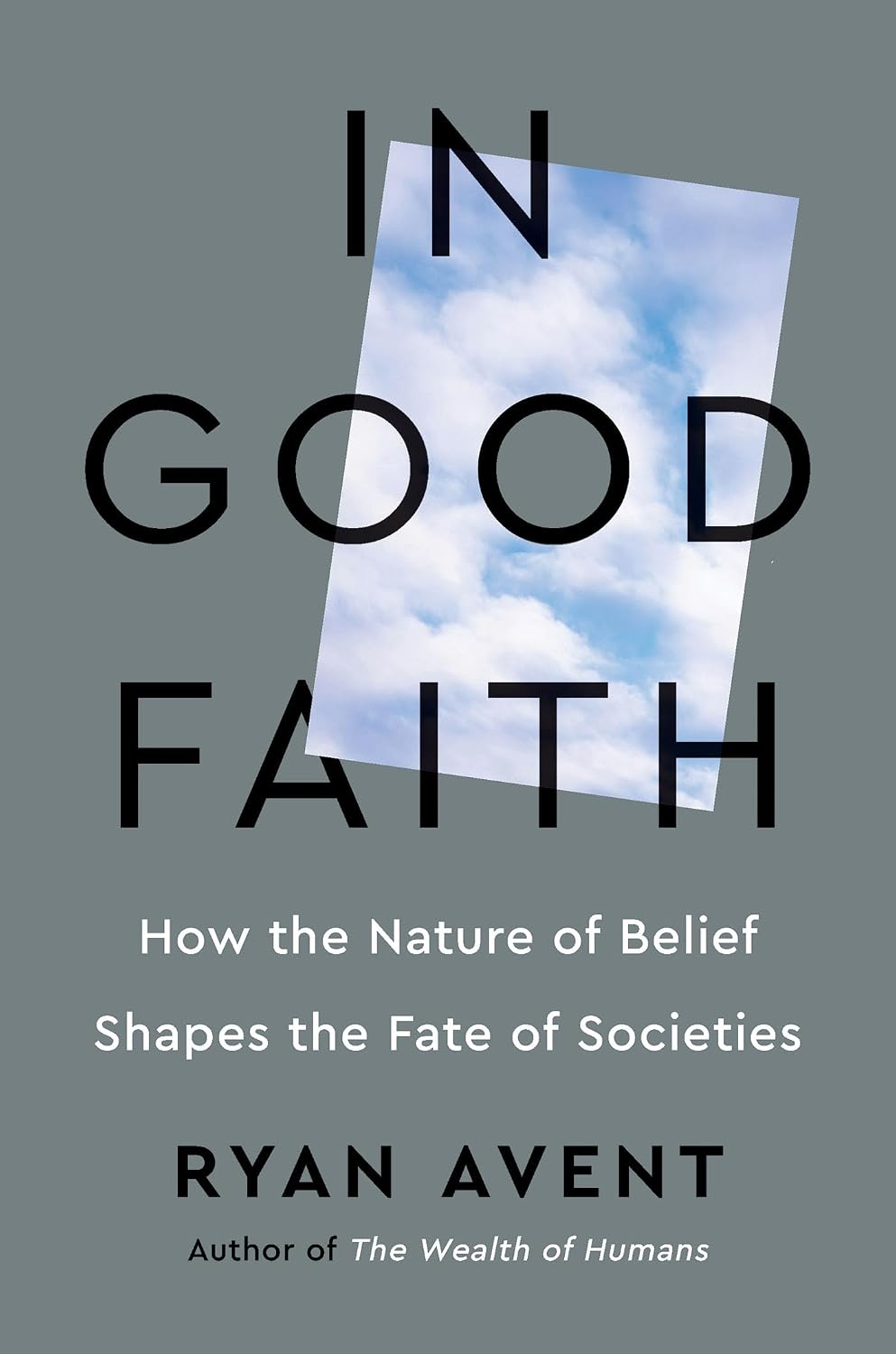
Ryan Avent is an American journalist who has written a thoughtful if frustrating book which perhaps sheds more light on himself than his subject. His thesis is that the formation of shared beliefs is central to the human ability to form and sustain complex societies, and that modern pressures are destabilising those systems of belief. Our acceptance of abstract systems such as money, the rule of law and nations, key to modern societies, operates as they are widely accepted. While powerful, these belief systems are fragile. Reliance on trust and narratives helps to make societies good at cooperation but vulnerable to breakdowns in trust. Avent argues that the combination of globalisation, social media and political polarisation have disrupted shared belief systems. Weaker shared beliefs erode trust in institutions and experts, undermining adherence to previously accepted rules. This is expressed by declining institutional effectiveness and the spread of conspiracy theories. For Avent, societies don’t collapse just from bad policies; they collapse when people stop believing in the system itself. Avent doesn’t identify a belief system which should be promoted but argues for making systems worthy of trust again. Shared belief itself holds complex societies together and is today under serious pressure.
The view that societies depend on shared beliefs is not a new one. ‘Every kingdom divided against itself is brought to desolation, and every city or house divided against itself will not stand’ (Matthew 12.25). Early modern rulers regarded religious conformity within their realm as self-evidently necessary. That concern has been recognised and analysed by each generation. Two questions arise. Does Avent add anything new to the debate and are his concerns about our generation well founded?
Avent’s analysis is essentially that Christianity led to the development of ‘modernity’ and that since a golden age after 1945, the near universal support for liberal values in the western world has fallen away. He identifies social media as a particular problem, ‘bequeathing to our children a cultural wasteland’. He sees ‘cultural nihilism’ emerging from a focus on self-interest. This has led to an erosion of trust in institutions and authority, to be replaced by a morally bankrupt world interested only in material comfort and leaving room for illiberal ideas.
Avent’s work as a journalist is evident. His style is accessible, if wearing, in a book and he has a tendency to make sweeping statements. To take two examples among many, he attributes the Industrial Revolution to the impact of Christian ideas on European society; ‘we might imagine three broad channels along which the Christian revolution reshaped the social environment, allowing the societies of northwest Europe to stumble on industrialisation first’. There may be an argument to be made that Christianity contributed to the growth of respect for the rule of law and individual liberty, but the claim that the consequence was ‘a society primed for the outbreak of modern economic growth’ is surprising. The causes of the Industrial Revolution have generated a very extensive historiography. To ignore that work and conclude as he does, based on a very limited view of the issues which historians have identified, illustrates a recurring problem with Avent’s work. He makes sweeping claims with great confidence, but with limited support. To claim that industrialisation rested on ‘the cultural aspiration to do things the way they are supposed to be done’ reflects a remarkable ignorance of eighteenth and early nineteenth century England. The impression is of a journalist looking for support for his views, but without the time to do the necessary research. The second example of this tendency for generalisation is the suggestion that, ‘in rich countries, most of us do most of our work to earn money for things we don’t have to have’. That may be true for some Americans, but this shows little sense of the economic realities faced by Americans living in poverty, not to mention the spread of income in other ‘rich countries’.
However, while his approach is frequently frustrating, an interesting picture emerges, if perhaps not the one that he intends. There are two threads. The first is his personal history of being brought up in a devout Christian family, losing his faith and suffering from depression. The second, perhaps related, is a view that society is ‘unravelling’ as we slide towards ‘societal dissolution’. For Avent, Donald Trump exemplifies the crisis. ‘There is no more staggering an indicator of the profound misoperation of American society than its decision in 2024 to return Donald Trump to the office of the presidency. It is madness to have put him there …’
This sense of horror at the result of the 2024 election seems to be at the heart of Avent’s analysis. How could America elect such a man? At the same time as seeking an explanation, he is attempting to fill the gap left by his loss of faith. He writes about his instinctive gratitude ‘for the sheer absurdity of being’, while not knowing to whom he should be grateful, having discarded the idea of a Creator. By the end of the book one is left with a sadness that Avent appears to be struggling with his loss of faith, exacerbated by his recognition of the value of faith, while having nothing to believe in.
One response to this book is to agree that Christianity did shape European society and that it played a role, if not necessarily an instrumental one, in the development of what Avent describes as modernity. The decline in belief has left many without a way to understand the world and their part in it, with an associated decline in mental well-being and a rise in anti-social behaviour which leads to distress. Indeed the book makes a good case that running a society without a shared moral system is difficult.
However Avent appears to confuse faith with confidence in the rational behaviour of others. He claims that ‘Faith is the great facilitator of a complex society because it allows us to dispense with doubt in many contexts’. He has confidence in the mRNA vaccine against Covid 19 and ‘in the assertions of a select group of experts. I have faith’. Whether or not one has faith, there is a crucial difference between the exercise of reason, in this case in the processes for creating a vaccine, and faith. Many will share the concern that western societies have lost direction and shared values. However Avent’s view that this can be achieved by ‘new stories’ is not compelling. Perhaps he might be happier and more optimistic if he considered the possibility that the faith in which he was brought up not only played a central role in the development of a society whose values he celebrates, and the loss of which causes him distress, but perhaps has a continuing role in human society.
‘In Good Faith: How the nature of Belief Shapes the Fate of Societies’ by Ryan Avent was published in 2026 by Yale University Press (ISBN 978-0-300-26992-5). 304pp.