
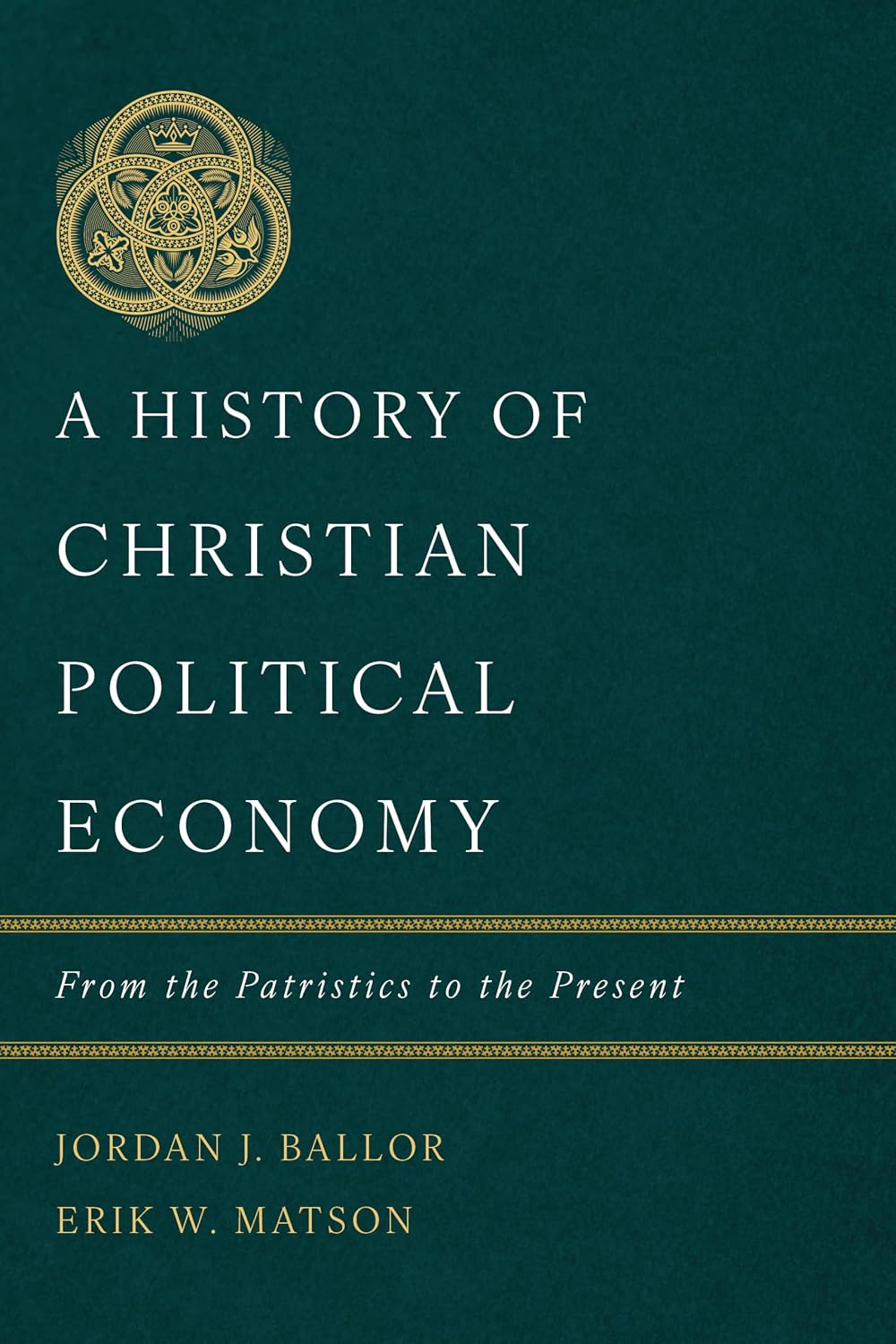
I have been waiting for books like these for a long time. The education of my childhood was classical and Christian, and upon discovering economics in college, it was immediately clear to me that economic questions and methods had classical, Christian roots. A few years after earning my PhD, I shared some of these thoughts in a Public Discourse essay titled ‘The Place of Economics in a Classical Education.’ My rising concern was that the new generation of students receiving a classical education was not being exposed to the best, original economic thinkers (such as the Late Scholastics, Bastiat, and Smith) and hence risked developing a warped view of how markets actually work.
After that essay, several leaders of classical schools reached out to me, asking for book recommendations so they could integrate economics into their school curriculum. I didn’t have one, solid recommendation – until now. While I have minor quibbles with the way they critique contemporary economic research in their final chapter, it is commendable that Ballor and Matson have filled a genuine gap in the literature and have done so thoroughly.
And that would have been enough. However, these volumes exceeded my already high expectations by including passages which were not only interesting, but edifying. It is not often that one looks up from a book on political economy, engrossed in the contemplation of divine things. This is, of course, what all academic textbooks should aspire toward, but how often do we settle for so much less. In a world that continues to drown in information and methods for organizing it, books that bear the marks of the genuine love of the authors for their subject matter will stand out all the more.
The History and Sources are organized around seven time periods: The Early Church, The Early Medieval Period, The Late Medieval Period, The Early Modern Period, The Classical Period, The Industrial Period, and The Twentieth Century. The History chapter provides a helpful overview of the economic and political conditions of the time, while the corresponding Sources chapter features selections from 7-9 Christian authors on various important debates of their day. The overall story arc that the authors discern is a move from ‘limited good’ to ‘mutual benefits.’ As they quote Bastiat:
The profit of the one is the loss of the other.
The profit of the one is the profit of the other.
Many early Christian writers believed the first, which is why it is dangerous for students to only read the ancients when it comes to economics. Although there were early visionaries of mutual benefit (such as Theodoret of Cyrus), it was later in history when thinkers such as Lessius, Smith, Ropke, and Pope John Paul II understood markets as a form of collaboration, mutual enrichment, and solidarity.
Two of my favorite passages found in the Sources corresponded to the Classical Period (1725–1848) and the Industrial Period (1848–1918).
In 1751, Ferdinando Galiani wrote:
Some find it strange that precisely the most useful things have a low value, while the less useful have a great and excessive value. Such persons should be reminded that the world is well constituted just for our welfare. What amazing good fortune! In general, utility is never matched with scarcity. Indeed, the more the basic utility of a thing increases, the greater the abundance in which it is found: hence, its value cannot be great (page 205).
What kind of value a market price represents is often something students have a difficult time wrapping their heads around. We instinctively know it is not a representation of intrinsic value, but we also know the natural market price tends not to solely depend on any individual’s valuation of the good. I look forward to using Galiani’s passages at length in coming years to help introduce students to the central economic concept of marginal value.
In 1908, Philip Wicksteed gave a lecture addressing the growing interest in socialism. In it, he takes great pains to describe what the British economy at that time was actually accomplishing: ‘The present system lays on every man the necessity, under penalties, of finding out somebody else to serve. If he does not, he cannot get his own purposes accomplished’ (page 266). He continues: ‘The present system has colossal defects, but, ideally and essentially, it is a spontaneous relating of activities to each other, on the principle that my purposes and my faculties are almost sure to fit each other imperfectly’ (page 267). There is something beautiful in the recognition that our dependence drives us to the market. We cannot be all things to ourselves, and much profit-seeking behavior is necessarily about noticing the needs of others.
A book on political economy is rarely nourishing to the soul – this one is. I could barely put it down. I wish, however, the authors had stopped the History once their Sources were complete after Chapter 7 (‘The Twentieth Century (1918-2000)’). While there was much I agreed with in Chapter 8 – such as the fact that the mandatory sequence in the history of economic thought should not have been dropped for graduate school in economics – the larger part of the final chapter seemed to be a capitulation to the urge to pontificate (pun intended) on matters only tangentially related to the text.
To take an example of a topic in which I have deeply read for a decade, the authors warn economists against practicing economics as an ‘imperial science,’ that is, applying economic logic to nonmarket decision making such as within the household or religious organizations. They write: ‘The positivist economic analysis of the phenomenon of marriage, for instance, reduces a rich and foundational social institution to a contractual relationship between rational utility maximizers’ (page 389). This is simply a misunderstanding of the purpose of academic research in economics, which is to try to understand why a social phenomenon occurs (such as years with different rates of divorce) using the logic of individual choice. In no way does Becker’s work on marriage and divorce as utility-maximizing somehow imply that more divorce should happen (or that it would be ‘good’ for the economy if it did). If anything, we have economists to thank for pointing out how rich and foundational a social institution marriage truly is! A large number of books (e.g., Kearney, 2023) and research papers in economics make this point over and over again.
On the whole, A History of Christian Political Economy and its accompanying Sources in Christian Political Economy were delightful reads. I would like to see them as required reading for Christian classical high schools, or certainly for economics majors at Christian universities. Warts aside (Chapter 8), the authors have done an immense service for us Christian economists who constantly hope for more of our brethren to see what we see in a quick run to the grocery store: the Lord’s providence.
‘A History of Christian Political Economy: From the Patristics to the Present’ by Jordan J. Ballor and Erik W. Matson was published in 2026 by B&H Academic (ISBN: 978-1-087-76633-1). 432pp.
‘Sources in Christian Political Economy: A Reader’ by Jordan J. Ballor and Erik W. Matson was published in 2026 by B&H Academic (ISBN: 978-1-087-76635-5). 352pp.