
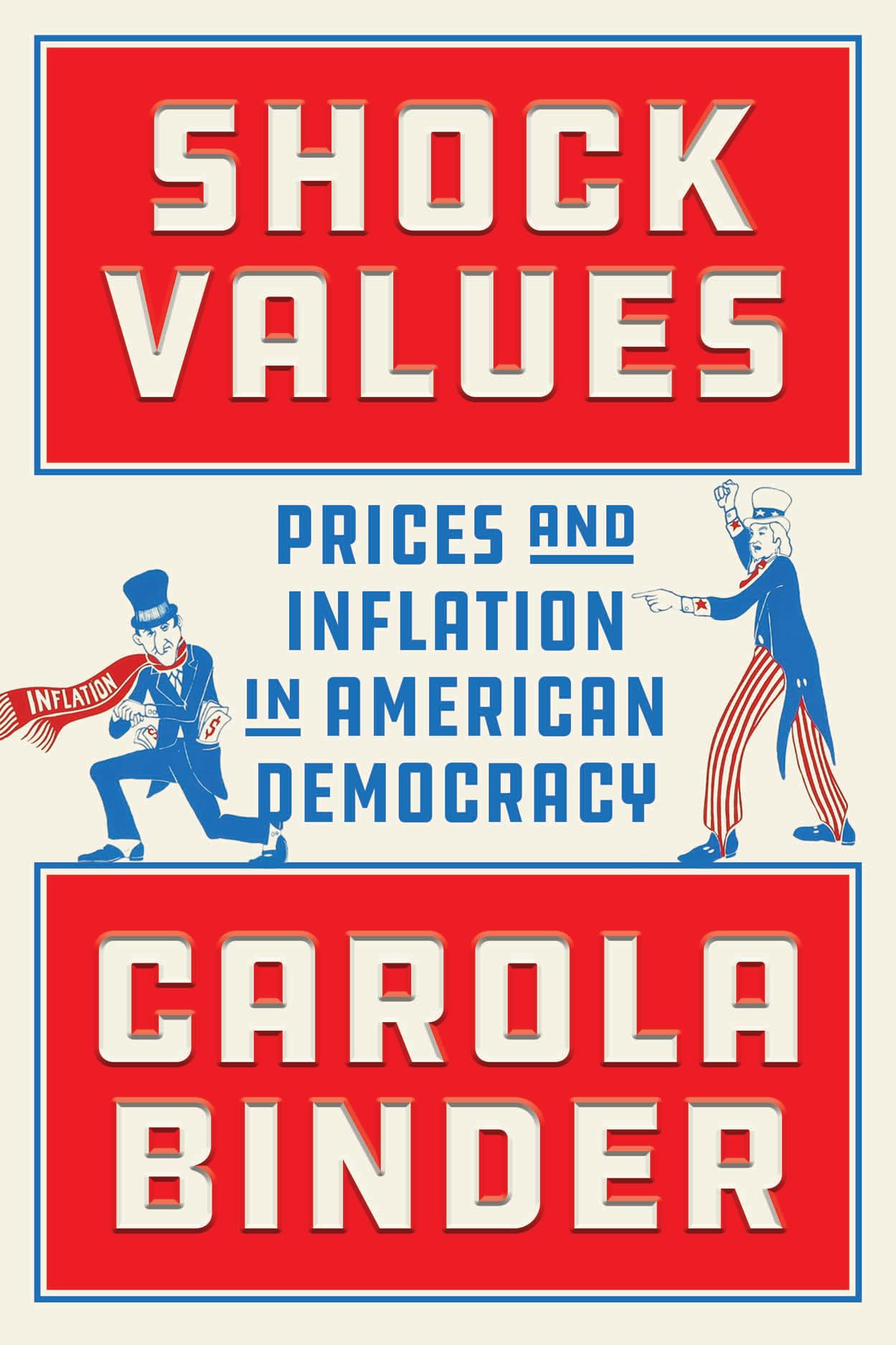
Why do Americans repeatedly turn changes in prices into arguments about democratic power? In Shock Values: Prices and Inflation in American Democracy, Carola Binder follows that question from the improvised currencies of the colonies to the inflation that followed the COVID-19 pandemic. That inflation brought renewed accusations of corporate greed, demands to punish price gouging, and proposals for direct controls. These responses, Binder contends, belong to a much older political tradition.
Her main argument is that American ideas about price stability and democracy evolved alongside one another. Debates over who should control money and prices have also been debates over political authority. She organizes the history of these debates around four themes: (1) price fluctuations redistribute income and wealth; (2) stabilization policies intended to address this redistribution often interfere with contracts and raise questions of due process; (3) emergencies have tended to enlarge the government’s economic role permanently; and (4) repeated crises and policy experiments eventually led the Federal Reserve to adopt an explicit inflation target.
The political response to economic crises follows a familiar pattern. Price changes help some groups and harm others. Those who lose lobby for compensation or protection to alter the result. Depending on the period, that pressure produced currency changes, tariffs, antitrust campaigns, rate regulation, price supports, or ceilings.
Price controls display this logic most clearly. From local committees during the Revolution to twentieth-century wartime agencies and Nixon’s peacetime freeze, advocates repeatedly treated high prices as evidence of misconduct by sellers. Supporters of price controls in Massachusetts blamed the rising cost of necessities on the ‘avaricious conduct’ of merchants; food trusts drew similar accusations during World War I, as did corporations after the pandemic. Enforcing such controls required officials to distribute scarce goods, detect evasion, and decide who qualified for relief from the rules. Those decisions generated another round of winners, losers, and political pressure.
Viewed against this history, the absence of broad federal wage and price controls after the pandemic is striking. Nixon imposed them in 1971, when inflation was well below its post-pandemic peak. In 2021 and 2022, familiar claims of profiteering and calls for direct intervention returned, but the federal government did not freeze wages and prices. Binder does not emphasize this contrast, yet it may be one of the most encouraging implications of her account.
Binder also shows how conflicts over prices reshaped political coalitions. Farmers supported inflationary reforms when deflation lowered crop prices, then backed proposals to stabilize the purchasing power of money. Progressive reformers were among the earliest advocates of a price-stability mandate for the Fed. Decades later, price stability became more closely associated with conservatives, while critics on the left accused the Fed of favoring Wall Street.
Binder is especially effective when she follows monetary conflict into the courts. The controversy over Civil War greenbacks illustrates why the legal questions mattered. Salmon Chase oversaw their introduction as Treasury secretary, then ruled as chief justice that applying their legal-tender status to earlier debts violated due process. After President Grant appointed two new justices, the Court reversed Chase the following year. Similar disputes accompanied later attempts to regulate prices and delegate monetary authority. Economic policy repeatedly forced judges to decide how far public power could alter private bargains.
Efforts to manage prices also changed the machinery of government. Every system of wartime controls required information, detailed rules, and enforcement. Delegating monetary management to the Federal Reserve raised a different institutional problem: how should experts be insulated from electoral pressure without escaping democratic accountability? Binder traces that tension from Andrew Jackson’s attack on the Second Bank to modern disputes over Federal Reserve independence.
Binder concludes by favoring a nominal GDP target over an inflation target. Her own historical analysis, however, complicates that recommendation. I agree that stabilizing nominal spending would be preferable in principle. It would allow productivity growth to produce falling prices and adverse supply shocks to produce temporarily higher inflation while keeping total dollar income on a steadier path. Yet the history recounted in Shock Values gives reason to doubt that such a regime would prove politically durable.
Some of the deflation from 1879 to 1896 reflected productivity growth. It nonetheless generated demands for tariffs, agricultural support, and monetary expansion, culminating in the free-silver movement and William Jennings Bryan’s 1896 campaign. Those experiencing falling prices cared less about deflation’s underlying cause than about its effects on their incomes and debts. Binder acknowledges that nominal GDP targeting is no panacea. Her history suggests a deeper political obstacle. Because such a regime requires the price level to adjust to supply shocks, its survival would depend on the public tolerating price movements that her historical actors repeatedly demanded the government reverse.
Economists often teach these events as technical problems. Binder returns them to the political world in which they occurred. She asks what Americans thought had caused a change in prices, who bore its costs, and what institutional changes emerged from the ensuing conflict. The book therefore explains more than why prices rose or fell. It shows how monetary controversy gave rise to constitutional arguments, interest-group conflict, and administrative change. Anyone seeking to understand the country’s economic history must understand those connections, and Shock Values is an excellent guide to them.
‘Shock Values: Prices and Inflation in American Democracy’ by Carola Binder was published in 2024 by University of Chicago Press. (ISBN 978-0-226-83309-5). 352 pp.