
The worldly wisdom of the corporate executive: A parable
Anyone who has worked in a large corporation, or NGO, or even public sector organisation, will be familiar with the dreaded term, Organisational Restructuring – as in, there’s going to be … A Restructuring. That means everyone’s jobs will change. Some people will advance a bit, some people will lose out a bit, and sadly some people will have to leave the organisation. It can be a time of horrible uncertainty, and it can bring out the worst in people.
Imagine a corporate executive who listens to what her CEO is saying on the monthly management calls – and realises that restructuring is coming. The politics is against her. It’s been made to look like it’s her unit which is underperforming. So, sadly, her time with the firm is going to end. She’s going to be made redundant and at a very awkward time in life.
And then she says to herself: ‘What shall I do? For the restructuring is going to take away my job. I’m not suited to more manual work. I don’t want to be reduced to begging. But maybe … I’ve got a better idea: an idea which will make sure there’ll be something for me after this – on the buy side.’
So she calls each of her clients one by one. She says to the first, ‘How much have we invoiced you this quarter, how much are you due to pay us?’ And the client says: ‘£100,000, as I remember.’ And she says to him, ‘Take the invoice I sent, quietly cross out £100,000 and write £50,000.’ The client is a bit surprised, but goes away not exactly unhappy at the retrospective discount. And then she says to the second client, who’s in the Eurozone, ‘How much did we invoice you?’ and the client says, ‘€100,000.’ And she says to him, ‘Take the invoice we sent you – and quietly write €80,000.’
And the CEO hears about what the outgoing executive has done, and the CEO is actually rather impressed with her. ‘Very shrewd,’ the CEO thinks – and perhaps he’s even regretting his restructuring decision. ‘Very shrewd, to use the company’s money to hand out these discounts, and make friends on the buy side on the way out. That might well give her a safe harbour after she leaves our organisation.’ Because the CEO knows a man or woman of the world when he sees one. And he knows wisdom – at least, worldly wisdom – when he sees it.
The worldly wisdom of the rich man’s steward: Jesus’s parable
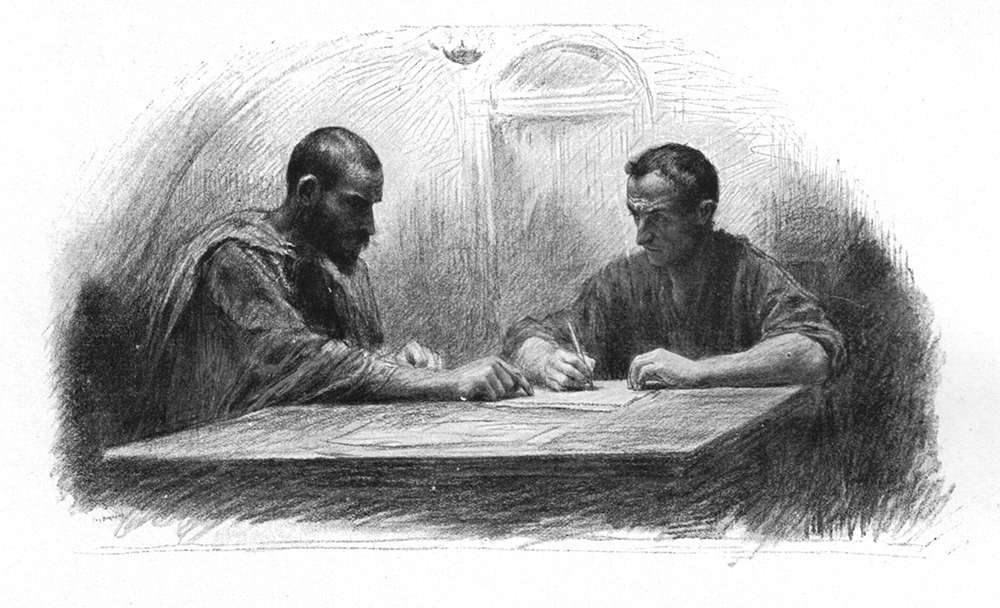
If you know your Bible, you’ll know that Jesus, perhaps surprisingly, tells a version of exactly this story. My parable is just a modernised version of Jesus’s famous one about the worldly wisdom of the rich man’s steward, a kind of estate manager, who is about to be dismissed. You can find ‘The Parable of the Unjust Steward’ in Luke’s gospel at the start of chapter 16. Like the executive, the steward goes round all those who owe his master money, and, to give himself some prospects for the future, gets them to discount his bills.
And what Jesus says to his disciples about his parable is something which most people initially find rather shocking. He says that, even though we are called to be children of light – and not children of this world – we can learn something from this kind of situation.
What on earth can we learn from these unedifying stories?
There are two things which Jesus suggests we can learn from his story, unedifying as it may first seem.
The first is that, even though as his disciples we are called to be children of light, and not children of the world, we must still live for now in the world as it is.
And in the world as it is we have to reckon with what Jesus calls ‘mammon’: with money, with finances, with all kinds of choices about how we acquire resources and how we steward them once we’ve got them.
The second is that in this world wisdom isn’t optional, but that there are higher forms of wisdom than the worldly wisdom, or shrewdness, of that corporate executive or unjust steward, who use their employers’ money to buy themselves into safety after the redundancy axe falls.
Jesus says that, when we as disciples deal with money, we must have as much, or even more wisdom, than the children of the world; not less. But it is not the same kind of wisdom. Jesus tells his disciples that we are to use our resources, and in particular our money, to make friends, to build relationships, yes; but not the kind of instrumental relationships of narrow self-interest sought by the worldly wise. Instead we are to form relationships which have ethical and spiritual integrity, friendships which will keep us safe, not just for a few years in a new role, or until we can take our pensions, but for eternity, because they are good for our souls. These friendships are as much, or more, about helping others, as getting them to help us. And we all have people we are in a position to help through our engagement in the economy: whether through our positive-sum exchanges in markets, or through our charitable giving, or even by paying our taxes.
Money as idol – Or icon?
We all know that mammon is able to express and cause all kinds of what previous generations would have called ‘unrighteousness’. And in fact in the passage Jesus calls it ‘the mammon of unrighteousness’. But that’s not all he says. He also says that mammon can be used for good. And that is the call Jesus makes to us in our economic exchanges: to use our money to do some good in the world, and to do ourselves some spiritual good in the light of eternity.
One way to express this is to say that human beings are always liable to make an idol out of money, to treat mammon itself as a kind of god. And indeed it is in this passage that Jesus famously warns us, ‘you cannot serve God and mammon’. He is telling us that only one of these can be ultimate in our lives. And that it is not in fact true wisdom to choose mammon as ultimate, but true foolishness, and indeed a kind of idolatry.
So let us not allow our use of money to make it an idol which competes with God. Rather let us make our use of money into the kind of beautiful icon we see in Orthodox churches, through which God’s goodness may be glimpsed. And if we can look at life’s challenges that way, we will find that God’s goodness helps us. We will find that Jesus’s call is not one we have to respond to solely in the strength of our small selves, but one for which we can draw energy from the transcendent, magnetic goodness of God, which we see revealed in the words and sacrificial love of Jesus himself.
Image: Drawing of L’Économe infidèle (The Unjust Steward) by Eugène Burnand, 1908