
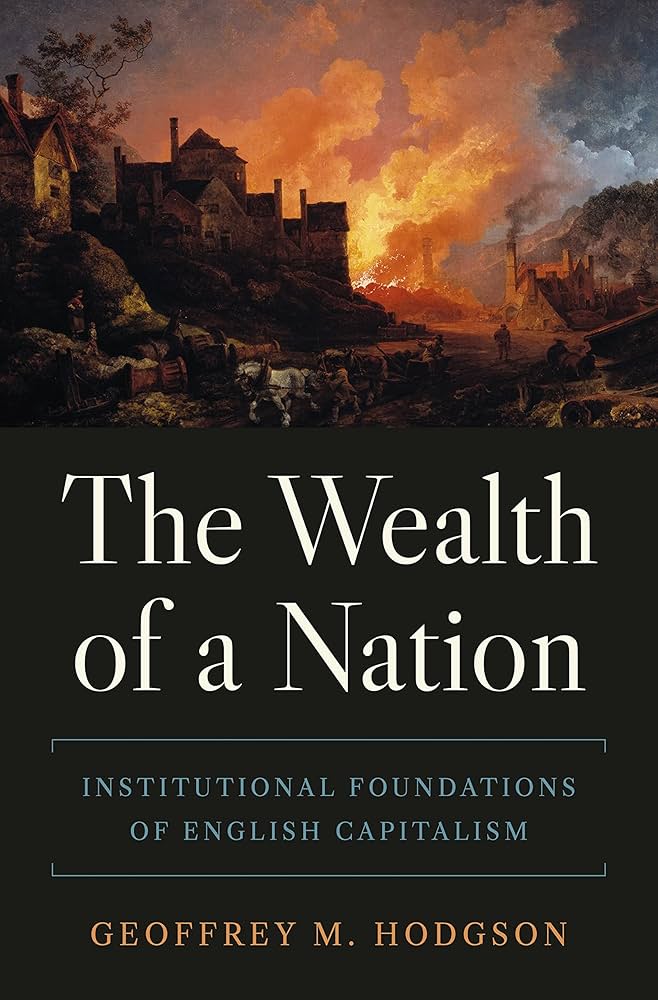
In this impressive work, Geoffrey Hodgson, a leading scholar in evolutionary and institutional economics, presents an interdisciplinary approach, including anthropology and neuropsychology, to demonstrate the fundamental importance of legal and financial institutions in the development of capitalism in England between 1300 and 1820. Determining the foundations of the ‘First Industrial Nation’ has long been a staple of economic history, often laden with a tendency to focus on quantifiable factors of production and resources, what Hodgson terms the ‘physicalist perspective in economics’ (page 182).
The notion of English exceptionalism has often informed historical accounts in this area, from self-congratulatory and often chauvinistic narratives of earlier centuries, which stressed nationalistic and religious attributes of ‘free-born Englishmen’, anti-Catholicism, and the virtuous worldliness of Protestantism, to those documenting the carefully-crafted application of hegemonic domestic and imperial economic policies. More recently, the cultural and intellectual dimensions of Enlightenment culture have been identified, especially by Joel Mokyr, as components of emergent capitalism.
While promoting a ‘legal institutionalist’ interpretation, Hodgson concedes that ‘multiple dimensions’ informed capitalist development (page 228). Yet, he seeks to revise an outlook whereby the apparatus of property rights, legal structures, and financial institutions have been understated in the historical literature. Thus, a ‘hidden wiring’ metaphor is appropriate, with the primacy of institutions representing a less fashionable, less heroic, and less visible element than the content of pre-existing interpretations.
The book is divided into three parts. Part I examines explanatory frameworks of capitalist development, including Marxist historical theory, as well as the role of technology, religion, and ideology. Part II, comprising over 50% of the book’s content, explains England’s economic development by reference to land, law, war, and finance. Part III narrows the focus by assessing institutions as drivers of economic transformation, while providing international comparative analysis.
Institutions – Not Ideology or Technology
The introduction presents the conceptual approach of ‘legal institutionalism’ with Thorstein Veblen and Joseph Schumpeter referred to as core influences. In Schumpeterian fashion, finance is held to have preceded enterprise, with rules-based institutions and organisations projected as the foundations and facilitators of transformation. A welcome semantic precision is employed in defining terms like ‘capital’ and in attempting to establish a sequential timeline of causal factors. Resisting Whiggish conceptions of linear progress, Hodgson argues for uneven development, especially of financial institutions and instruments, instancing that mortgaging rules were not established in England before 1670, and debt markets fully emerged only in the later eighteenth century (page 12 note 24).
Unpicking Marxist historical theory is a significant element of Part I. For Marx, law was not part of the economic base but rather the superstructure, yet Marx had to reference property since the social classes of capitalism were defined according to ‘specific institutional relations of property and power’ (page 47). Indeed, the very claim for an English bourgeois revolution is problematic, as the aristocracy retained enormous political and economic power, status, wealth, and privilege well into the twentieth century. With law considered constitutive of social relations, rather than simply an epiphenomenon, Hodgson allows himself the aphorism: ‘The history of all existing society is the history of institutional change’ (page 48).
Similarly, technology, religion, ideology, and culture are framed as limited explanations. China’s institutional failures in sustaining its earlier technological advances are taken as indicative of why technology alone is an insufficient explanation for capitalist development. Equally, while Calvinism, famously termed the parent of capitalism by Max Weber, ‘impelled a capitalist mentality’ of hard work, diligence, and literacy, it cannot explain the capitalist structures and institutions of non-Calvinist territories such as the Italian city-states (pages 55-56). Nonetheless, adjudging the different contours and outcomes might have been worth pursuing further.
Similarly, the presence of liberal ideas did not necessarily translate into policies or a particular policy agenda. The impact of Enlightenment networks, the ‘Republic of Letters’, and transmission of ‘Useful Knowledge’, even the influence of the great ‘Cultural Entrepreneurs’, Newton and Bacon, is taken as overstated, with too much weight ‘placed on too few extraordinary people’ (page 65). In sum, property rights, the rule of law, and financial institutions were more vital foundational factors, with transmission and circulation of knowledge depending on ‘higher-level evolution of organized authority’ (page 67). Hodgson viably suggests that the covert nature of evidence surrounding institutions, rules, and regulations often leads to historical understatement or neglect of these factors. The persistence of instincts and habits are also intriguingly referenced in the same sense.
Land, Commerce and Credit
Part II contains extended, and at times breathless, historical analysis. Thematically, the focus is on the transformative effects of landownership and warfare. The survival of feudal property laws are considered in terms of the limitations of capital formation and investment, with Entails and Strict Settlements reducing availability of marketable land, while also buttressing Primogeniture, meaning estates couldn’t be sold, divided, or collateralised (page 81). Land was an intergenerational trust rather than a marketable, collateralised asset, and across the centuries, landowners successfully prevented freer trade in land, while extensive enclosures facilitated greater concentration of landownership (pages 96-101). Not for nothing have historians adopted the term ‘Territorial Constitution’.
Socially, these events are correctly identified as misaligned with the Marxian ‘rise of the bourgeoisie’ with ‘capitalist’ landowners dismantling feudalism. Such a tidy pattern of development in social relations and economic policy seems too reductionist. An economic mosaic appears more accurate, with the Aristotelian legacy via Aquinas, natural law ideas of ‘just price’, and residual anti-usury sentiment vying uneasily with foreign trade monopolies and restrictive customary practices, into a period of supposed economic modernity and individual freedom. In fact, as Anthony Howe, Miles Taylor and others have described, many bourgeois were willingly coopted by the aristocracy, to the fury of Radicals like Cobden and Bright. Conversely, aristocratic attitudes towards commerce remained ambiguous. Despite the presence of many landowners in commercial ventures, it could take generations before, as Sir Lewis Namier famously related, ‘the stain of trade’ was eradicated.
In England, no government department was exclusively concerned with land, nor was there a Land Registry. The absence of the latter meant land sales and mortgaging were further inhibited (page 108). Moreover, with no English equivalent to the French Notaires, mortgaging was mostly conducted on an ad hoc basis by attorneys and scriveners acting as financial intermediaries. As transactions were likely widely-dispersed and with many as yet undiscovered in private archives, the importance of mortgaging may be understated. Nonetheless, the book intermittently details the vibrancy of local credit mechanisms and networks, with the Manchester cotton merchant Samuel Greg mortgaging land, and mortgaging also applied to lenders receiving toll revenues generated by investment in canal, river, and turnpike infrastructure. Country banks were also important to development, with Adam Smith arguing that the ‘most judicious operations of banking can increase the industry of the country’, but even by 1776 this remained as much an aspiration as a reality.
The orthodox view of early industrial finance was that it was largely self-generated (pages 158-159). Family firms and partnerships were based on trust and honesty in periods where limited liability was not yet legislated, and joint-stock status was reserved for highly-capitalised ventures, like Chartered Companies. Though start-up costs varied, capital formation was not always easy, and even Boulton and Watt had difficulties securing reliable sources of capital (pages 175-180). Nonetheless, England found a way.
Warfare, Finance and the Role of the State
Warfare in the form of the ‘Military Revolution’, consisting of more powerful firearms, stronger fortifications, and larger standing armies, features as a vital catalyst for State-based institutional development. The author adopts a traditional interpretation of the emergent Fiscal-Military State, with war the forcing-house for the creation of financial institutions, as previously noted by John Brewer, Werner Sombart, and Francis Fukuyama (page 155). Though not purely an English phenomenon, England was the primus inter pares whose State-building and institutional development advanced after the 1688 Glorious Revolution, aided by the sophisticated apparatus of ‘Dutch finance’ which ultimately created a pathway to industrial growth (pages 164-165). Despite indications that the process began earlier, under the Protectorate, the paradigm shift whereby England, as a Dutch ally, engaged in European and colonial conflict throughout the ‘long’ eighteenth century is fairly established. The contrast with Japan, South Korea, and Taiwan demonstrates similarities and differences in path dependency, but the notion that there exists a template for understanding economic development remains elusive.
Ultimately, Hodgson presents an interpretation of the imperatives of war finance overcoming the structural limitations of using collateralisable assets, especially land, for capital investment. Yet, despite any perceived shortcomings, perhaps Entails, Strict Settlements, and Primogeniture actually promoted the essential systemic stability for economic growth. The ‘Territorial Constitution’ was the institutional articulation of the permanence of land, and the political authority of the landed classes, and capitalism could only evolve and thrive if widespread confidence existed in the legitimacy of financial and political authorities and institutions. Additionally, the role of the State as a more interventionist economic actor is perhaps understated. The expansive protectionism of earlier centuries, including Navigation Acts and sector-specific tariff schedules, were influential in industrial growth, with the cotton industry a notable beneficiary of a deliberate ‘infant industry’ tariff strategy. Equally, the institutional maturity of England can be questioned. A considerable raft of commercial legislation, providing codification and legitimacy, had to wait until the nineteenth century, with repeal of the Bubble Act (1825), Bank Act (1844), Joint Stock Act and Limited Liability Acts of the 1850s and 1860s creating a more identifiable and self-conscious commercial society.
An Institutionalist Approach
Hodgson has produced an interesting and thoughtful book which, perhaps inevitably in such a wide-ranging and ambitious work, underplays some features. Occasionally, the prose is a little staccato, but mostly it is measured and even, and the pace neither leisurely nor hurried. The book is recommended as a valuable addition to the fields of legal institutionalism, economic history, and development studies.
There is a sense that histories which ‘discover’ new features or relate understated factors often meet a receptive audience, as they can appear to validate historical study, and by extension, the historical profession. Hodgson’s book fits that category but more granular research needs to be conducted before the institutionalist theory can be more fully validated and readily accepted.