
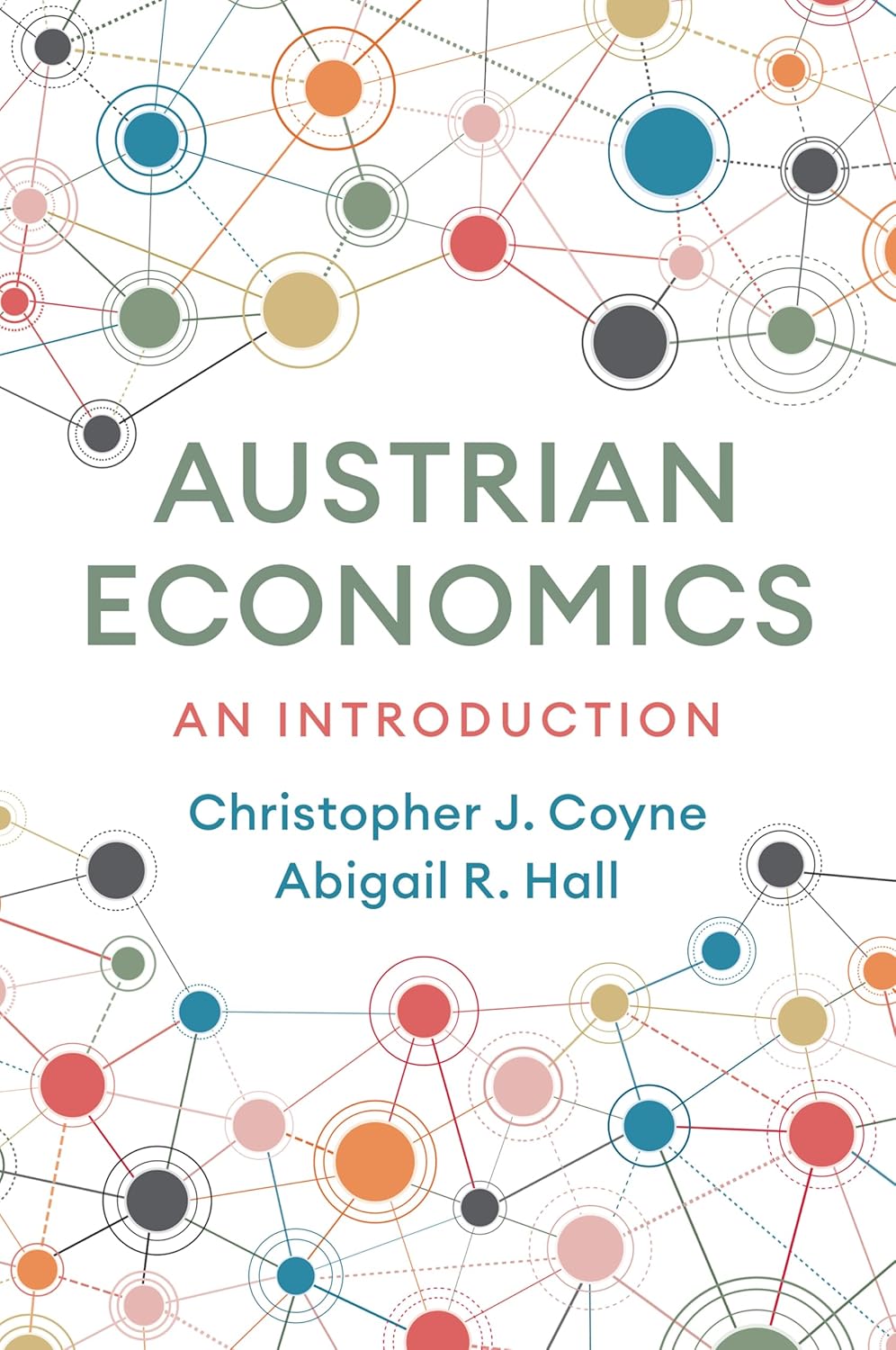
Christopher J. Coyne (George Mason University) and Abigail R. Hall (University of Tampa) have published an elegant book introducing readers to Austrian economics.
I propose a brief – though far from comprehensive – list of Weberian ideal types who would benefit from reading it. Anyone who:
- thinks Austrian economics is a bunch of pseudoscientific mumbo-jumbo designed to obfuscate the ideological machinations of dark money billionaires
- has a vague notion that the founder of Austrian economics is Satoshi Nakamoto
- considers it preposterous to include ‘human’ and ‘science’ in the same sentence
- mistakes an ‘is’ for an ‘ought’
- is puzzled by why a Central European country with a stagnant economy continues to generate so much interest
- is considering reading up on ‘Australian economics’ one of these days
- just knows that Austrian economics justifies/assumes greed, selfishness, and/or ‘atomism’
- is ‘very online’
- was taught Austrian economics opposes ‘empirical evidence’
- reifies ‘the market’
- remembers an economics course featuring bloodless charts and diagrams, full of sound and fury signifying nothing
- is a politician (– Hey, a boy can dream!)
(Note: Any resemblance to actual people is completely intentional).
How Austrian economics found itself in need of expositors to dispel such notions is a story for another time. But after this book, no one has an excuse for clinging to these caricatures. In Austrian Economics: An Introduction, readers will learn quickly that Austrian economics studies how people cooperate to improve their lives. They will also learn what stymies such cooperation and how government efforts to override peaceful choices often produce unintended consequences.
Chapter one describes the main themes of Austrian economics and how those emphases distinguish the tradition from prevailing frameworks today. It does so by weaving these ideas through the biographies of key Austrian figures, beginning with founder Carl Menger and extending through Böhm-Bawerk, Wieser, Mises, Hayek, Lachmann, Rothbard, and Kirzner. The authors place Austrian economics within the broader marginalist tradition. At the same time, strong commitments to methodological individualism, subjectivism, time, institutions, and resource heterogeneity differentiate Austrian economists from their neoclassical cousins.
The payoff of these Austrian hallmarks is a distinctive approach to prices, capital, money, business cycles, and social order more broadly. Austrian theory is more concerned with realism than most standard neoclassical models, but realism is not valuable for its own sake. Coyne and Hall show that Austrian theorizing aims at something deeper: insight into social processes, the kind that enables ‘pattern predictions’ – directional claims about the tendencies of an economic system (chapter two).
Chapter eight puts this pattern prediction capacity on the fullest display. Here, Coyne and Hall walk through the Austrian business cycle theory (ABCT), the Mises-Hayek account of why modern economies exhibit economic booms followed by busts. In the ABCT, the Austrian tradition’s signature insights converge. By integrating the Austrian analysis of prices (chapter four), entrepreneurship (chapter five), interventionism (chapter six), money (chapter seven), and capital theory (chapters one and eight) into a single framework, the ABCT illuminates social phenomena other approaches struggle to explain. Why, for example, do economic booms see entrepreneurs pouring resources into ‘higher-order goods’ (say, mining) even as final buyers go on a consumption spree? ABCT explains.
Much of the core Austrian material will be familiar to readers already steeped in classic Austrian works. But seasoned lay readers of Austrian economics, and even professional Austrian economists, will benefit from two chapters that set Coyne and Hall’s book apart from the competition. Chapter three – ‘Catallaxy: The Study of Coordination and Exchange’ – situates Austrian economics within a broader intellectual tradition Coyne and Hall call ‘the exchange paradigm.’ The term, borrowed from Dartmouth economist Meir Kohn, refers to a broad umbrella that includes several fellow-traveler traditions in public choice, law and economics, and the new institutional economics. Unlike the Hicks-Samuelson ‘allocation paradigm,’ the ‘exchange paradigm’ emphasizes price formation (rather than optimization against exogenously given prices), imperfect information, constant change, open-ended choice, and the specific knowledge of time and place. Because such knowledge is tacit and thus inarticulable, it resists the dominant ‘measure-and-model’ approach.
As with chapter three, seasoned scholars will find much to learn from chapter nine: ‘Austrian Economics: Yesterday, Today, and Tomorrow.’ In it, Coyne and Hall survey contemporary Austrian research – much of it from the last decade – spanning a host of domains: political economy, macroeconomics and monetary theory, entrepreneurship, development, behavioral economics, self-governance, culture and civil society, and the economics of disasters, diseases, and war. This chapter highlights the profoundly empirical nature of modern Austrian scholarship. Austrian economists want to understand how the world works and why things are the way they are.
The book repeatedly revisits economic calculation and the coordinating role of market prices. This repetition is a feature rather than a bug. Consider interventionism. The Austrians note that intervention alters prices, the distorted prices change behavior, and the new behavior often undermines the very goals the intervener pursued. Coyne and Hall rightly highlight how the rest of Austrian economics builds on the central contribution of economic calculation.
Given their mastery of the literature, I’d hoped Coyne and Hall would include chapters on other areas of economics where Austrians have been pioneers. The book might have explored Austrians’ substantial contributions to law and economics beginning with Menger’s discussion of property rights and followed by Hayek’s distinction between ‘law’ and ‘legislation.’ It could have also fruitfully featured an industrial organization chapter to highlight how Austrian market process insights (chapter four) provide a distinct lens on public policies such as antitrust. Though these chapters do not appear, I hope that means Coyne and Hall have a sequel in the works.
The quality of the book’s prose is a credit to the important ideas it contains. If Austrian economics has been on the cutting edge of many important intellectual contests – the 19th century Methodenstreit (the ‘battle of methods’), the 19th century Marginal Revolution, the 20th century socialist calculation debate, the 20th century contests over business fluctuations, and contemporary debates about everything from foreign aid to reinvigorated industrial planning – it deserves an accessible treatment that simplifies these Big Ideas without being simplistic. Chris Coyne and Abby Hall have delivered. Faculty now have a great option for courses on Austrian economics, public policy, political economy, economic history, and the history of economic thought.
One final note. Coyne and Hall’s endnotes and bibliography are worth the price of admission. Anyone hungry to learn more – and many will be after this appetizer – will find an intellectual feast awaiting them in the References. When it comes to the human sciences, there is enough here to occupy one’s mind for a lifetime. With so much to read and too little time, it’s good we have prices to guide us. At least when it comes to this new book, I think readers will conclude the marginal benefit exceeds the marginal cost.
‘Austrian Economics: An Introduction’ by Christopher J. Coyne and Abigail R. Hall was published in 2026 by Polity (978-1-509-54706-7). 222pp.