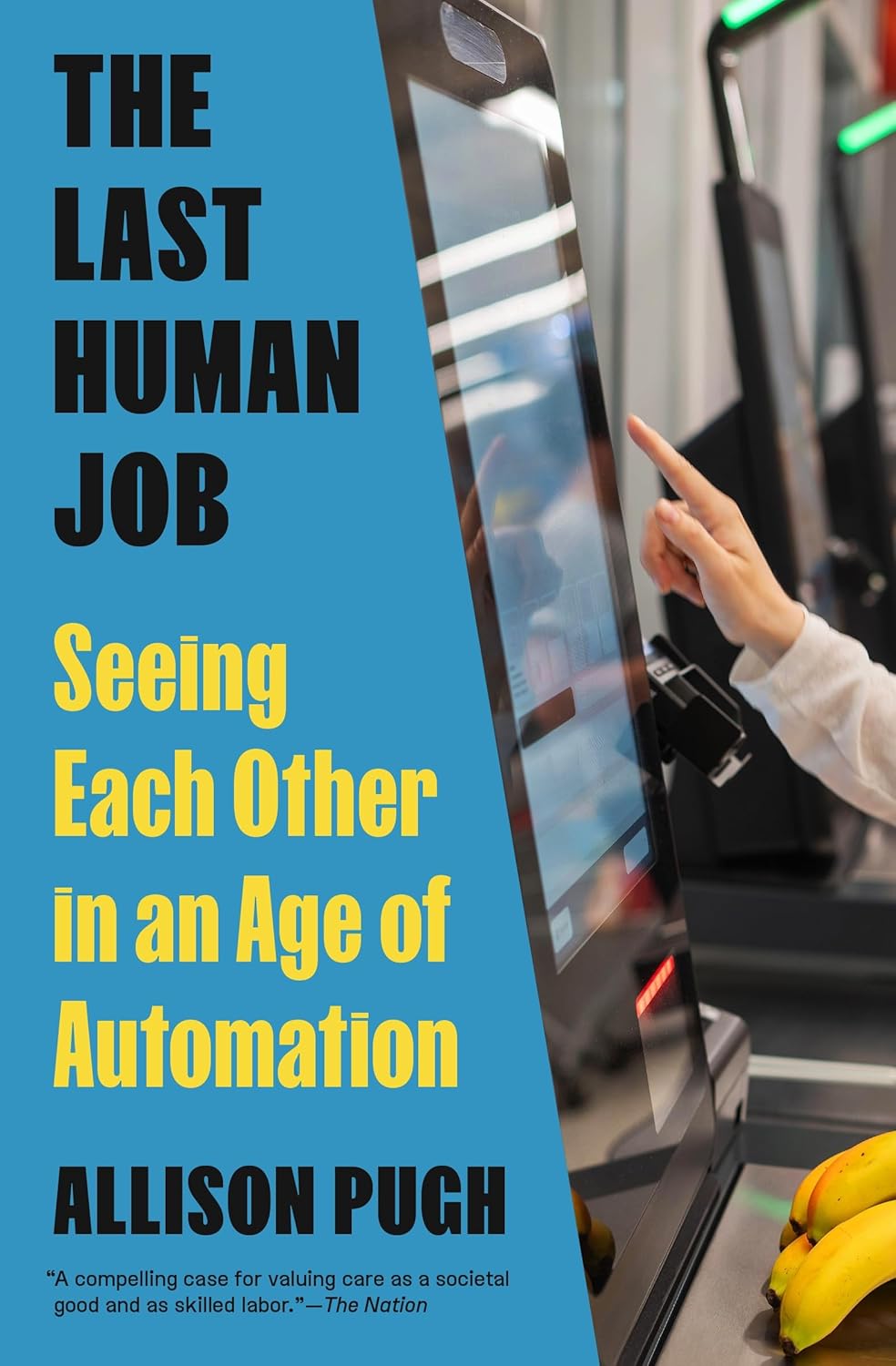
I was struck while reading this book on the plane as a flight attendant passed through the cabin with his trolley, asking, ‘Any waste, rubbish or trash?’ Three words to say the same thing, I thought, but a clear attempt to do exactly what this book was describing: connect with people who experience and express things in different ways.
The Last Human Job is premised on the concept of connective labour as an essential element of human relationship through work. ‘The crux of this labour,’ Pugh tells us, ‘involves “seeing” the other and reflecting that understanding back. … Yet it is work that is essentially invisible, only partially understood, and not usually recognised, reimbursed, or rewarded, despite its ubiquity and importance’ (page 2). It is also, Pugh argues, only doable by a human being.
Pugh endeavours to prove this by sharing the studies and interviews she has undertaken with people working across a range of professions whose success relies on connective labour. She shares the stories of chaplains, nurses, teaches, therapists, cashiers and sales staff, and argues that human beings and connective labour must be protected in an age where automation and artificial intelligence are trying to create shortcuts or replace them.
The book is in itself an attempt at connective labour as Pugh seeks to break down complex psychological and sociological concepts and terminology for the reader. Whether or not she achieves this depends also on the reader and their ability to understand the scientific analysis within the book, which is unavoidable and also gives this research its credibility. I would argue that for the non-scientific reader, of which, as a musicologist and ethicist, I am one, Pugh’s message resonates most when supported by the voices of her interviewees, which are quoted directly and conversationally: ‘I was just like, something was kind of off, like, it didn’t feel the same’ (page 117).
I would argue that this, too, lends the book credibility and is what makes it accessible to an audience which reaches well beyond the academic readership such research might traditionally attract. The anecdotal style might seem jarring at first, compared to the formal analytical prose which precedes these examples, but Pugh weaves these voices in throughout the book often making it feel more like a narrative with characters who the reader gradually gets to know over the course of its nine chapters. The result is that reading The Last Human Job does not feel like someone is explaining something to or at you, but rather that you are there in the room with them, learning and growing in understanding of each other as human beings, and equipping the reader with the skills to improve one’s own connective labour practices in work and daily life.
A lot of Pugh’s theory seems obvious: be a good listener, use your body language to make others comfortable, speak with authenticity. However, the reality described by those who do this work is much more complex: motivate a depressed stage four cancer patient to take their medication, inspire a truant pupil who is living in poverty and abusive parental relationships to come to school. There are challenges which humans face which a machine or automated sequence are simply unable to fix.
Pugh proposes that we are in a moment of ‘cultural reckoning of what it means to be human’ (page 60), and argues that as a result of increased automation and loneliness, we are ‘in the midst of a depersonalisation crisis’ (page 282). Discussion of artificial intelligence figures surprisingly little in the book, and Pugh does not reject or negate its positive uses and attributes. However, her focus on human relations and connection, and her thorough exploration of various and sometimes surprising professions and the connective labour they involve provide the critique in itself. For example, a lot of time is devoted to the work of chaplains in hospitals.
My ten years of working in social justice policy, research and programmes in the Catholic Church have given me, I will admit, a not entirely unfounded but certainly prejudiced expectation that religion or spirituality is somehow frowned upon by the more ‘logical’ fields. In addition to this, we are living in a cultural context in the UK where religious literacy seems to be increasingly non-evident. I therefore found it pleasantly surprising that a scientific book would consider such a profession as worth exploring at all.
‘The power of connective labour,’ Pugh concludes, ‘is in its capacity to knit together communities of disparate souls – in other words, to create belonging’ (page 280). Human beings crave recognition, not in terms of fame, but feeling understood and that they belong: ‘Through connective labour, we enact respect for the other; across our differences, witnessing conveys that someone is a fellow human being who deserves to be known’ (page 282). If this all seems a little too sugar-coated, we are brought back to reality a few pages later when Pugh gives us the stark choice: ‘the real question we face in an AI future is whether, as humans, we choose to be pets or livestock’ (page 282).
Pugh admits that the future she is proposing, one in which authentic human relationships rule supreme, seems ‘almost utopian’ (page 288); however, she also states, and I too was convinced, that the stories and cases she has recounted over these 365 pages prove that it is possible. In the same way that the readership of feminist literature is mostly women who often already know and agree with what they are reading, The Last Human Job is surely more likely to attract an audience which is already seeking to build the future for which Pugh is advocating.
Much like feminist literature, I hope that The Last Human Job will also fall into the hands of those who may not necessarily immediately agree with its argument. I would suggest that the people in the powerful position of shaping the future through AI and automation could do with receiving a copy as a matter of greater urgency.
The Last Human Job is more than a piece of sociological research, it is a masterpiece in the art of connective labour, at times technically challenging, other times deeply moving. Pugh tells us early on that ‘in German, the world Herzensbildung means “training one’s heart to see the humanity of another”’ (page 24). The Last Human Job is calling us to rise to this challenge.
Some airline companies now provide their flight attendants with a badge on which is printed their name and the flags of the countries whose languages they speak, evidently to help those passengers for whom the standard English announcements may not be easily understood. So, as I sat on the plane reading with this book with my empty plastic cup ready to throw into the rubbish cart, I looked up and saw a Spanish flag on the flight attendant’s badge. ‘Gracias,’ I said, and smiled to myself.