
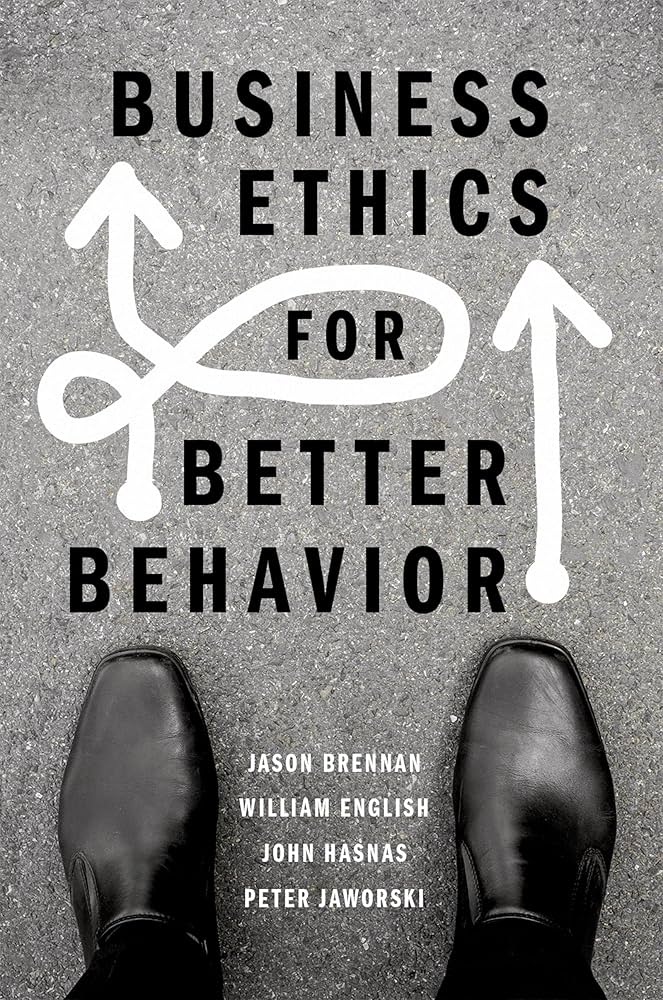
This is what an ethics textbook looks like when you actually care about helping people to be more ethical. It is profoundly refreshing in its appreciative treatment of business and of market institutions, whilst humbling the reader in demonstrating the vast scope for moral failure that is possible even within a fairly good institutional structure. The book avoids getting bogged down in the core philosophical questions of normative ethics, and rather concerns itself chiefly with how we can avoid non-controversial moral failures: cheating, lying, stealing, and shirking responsibility, and telling ourselves we did nothing wrong.
The authors are a group of moral and political philosophers and legal scholars working at the Georgetown University’s McDonagh School of Business. There, they have innovated in the teaching of business ethics and compiled a textbook informed by their overlapping vision of the field and their experience in the classroom. The book not only offers a refreshing new way of thinking about ethics in the world of business but philosophically justifies it in a way that is itself pedagogically valuable. This is a strong textbook around which to build an ethics course, or even program, in a vocational educational setting like a business school. But more than that, it is a manual for the morally conscientious. The book address itself to people who want to be good, to help others to be good, and work in or manage organisations that avoid bringing out the worst of human nature. Chapter 1, Why Do Good People Do Bad Things?, and Chapter 2, Why Are We Not All Saints?, synthesise the moral philosophy, moral psychology, and social psychology, on selfishness, moral confusion, cognitive biases, incentives, moral blind spots, and weakness of the will, to break down any preconception the reader might have that acting immorally is just what other people do, because they are simply bad people. There are universal features of our psychology and the institutional world in which we find ourselves that set even well-intentioned people up for moral failure in predictable aways. The purpose of the book is to prepare students for the stumbling blocks they will face as entrepreneurs, managers, employees, and citizens, so that these may be anticipated.
The authors argue that business ethics should not be an afterthought or a cherry-on-top of entrepreneurship, as if the only question of ethics that arises in the course of economic cooperation is what one should spend one’s profits on. Business ethics is often reduced to the mere study of ‘Corporate Social Responsibility’ (CSR). Morality is not limited to transient fashions of corporate governance and political ideologies. Ethics – like legal compliance – should be built into one’s business plans from the very foundation. What kind of person do I want to be? How do I want to achieve that? How will I treat my customers, partners, employees, and bystanders, in the process? How does my product or organisation make the world a better place? How will I know if I have succeeded or not? These are all questions one should ask before one engages in entrepreneurship, not after. (pages 13-16)
The CSR-based model of business ethics also sells business short. It implicitly assumes that businesses do nothing good for society until they decide to implement some scheme in which they donate profits to charitable causes, or what have you. But for a firm to even have profits for which this question arises presupposes that they already have in fact served society quite substantially: in providing something of value that other members of society deem worthy to part with their cash for. We often assume that because a business is profitable, the only motive its managers and owners have is producing income for themselves. This assumption is a case of extrinsic motivation bias, in which we imagine other people (but not ourselves) to be more extrinsically motivated than they are. The converse of this is the assumption that firms who practice CSR do so only for intrinsic reasons, and not because it often improves their bottom line (pages 203-207). However, even if this were true, the typical result of self-seeking economic behaviour in a well-governed marketplace is the provision of value for others. The more profit a firm makes tends to be indicative of the amount of value they have provided to their customers. Service to others, accounted for through profit and loss in a competitive marketplace, tends to be a more accountable mode of social beneficence than CSR (pages16-22).
The authors clearly echo the idea, most famously ascribed to Adam Smith, that economic agency in market conditions tends to economise on virtue and align our incentives with the good of others. In equally Smithian spirit, however, the authors clearly believe that this is far from the final word on the question of ethical conduct in business.
The book can be divided into three sections. The first (chapters 4-6) deal with moral confusions that might lead us into immoral conduct: chiefly moral relativism and the conflation of ethics with mere legality. The authors cut through these distinctions to show when, how, and why cultural variation is relevant from a moral perspective (for example, different rules and conventions that societies have for concluding contracts or of showing hospitality) and when it isn’t (for instance, when a society deprives foreign workers of their passports in order to de facto enslave them). The philosophical analysis and argumentation in these parts is accessible but robust. These chapters could and should supplement courses taught in philosophy departments.
The second section (chapters 7-10) deals with the question of incentives. Do normal people merely respond rationally to material incentives? In Smithian fashion, the authors argue that whilst we are significantly self-regarding, we not only desire material wellbeing but social esteem in society. We need to be able to think of ourselves as good people so that we can present ourselves as such to others (partially for its own sake, partially to secure their cooperation, which in turn benefits us materially). This presents an internal limit to our otherwise ‘rational utility maximization.’ We will often opportunistically cheat the rules of morality when it benefits us, but only to the extent that we can tell ourselves a plausible story that rationalises or minimises it. Limiting the scope for such rationalisations is therefore a crucial criterion for setting good rules – out in society and within the firm. This section gives a working account of game theory and how a concern for our own reputation is beneficial to us in strategic circumstances. The authors argue that if one were a psychopath who lacked any empathy for other people, it would be materially rational for one to wish this away since, actually having empathy for other people and being intrinsically motivated to be honest and trustworthy is a better way of doing well in life than merely pretending to for strategic reasons. The authors give a helpful and empirically informed overview of the varieties of collective action problems that can arise in societies and within organisations, both public and private. They demonstrate the different ways in which incentives can be aligned, and accountability baked in, so as to decrease bad behaviour, and show which ones are fitting for which scenarios, and how to identify them. They also detail attempts businesses have made to align incentives that have ended in disaster.
The third section (chapters 11-12) deals with our psychological limits. The authors reflect on the research on the depletion of will-power that finds the strength it takes to do the right thing in the face of temptation is a lot like physical strength. Taking this seriously means two things: that using will-power has opportunity cost and that will-power can be trained. We should avoid situations in which we will have to ‘spend’ our will-power if we know that we need to conserve it for something more important later. (If you are going to have a difficult meeting dealing with professional conflict, it would be good if you had not had to spend the whole day resisting the bowl of M&Ms sitting on the reception desk.) Taking steps to ensure avoidance of unnecessary exposure to temptation enables greater moral heroism in the face of the unavoidable challenges we have to address. However, it also means that repeated, manageable exposures can give one a greater capacity to do the right thing in the face of temptation. The authors also reflect on empirical research on ‘moral blind spots’. Just as we use decision-making heuristics to reduce the ‘transaction costs’ of executive functioning, and these heuristics often break down in predictable ways (e. g., in the face of novel circumstances), our moral heuristics can also break down such that we fail to notice what the moral stakes of a decision were – they are in our moral blind spot. This can occur due to the framing of a decision (for example, Is this a technical problem or a legal problem? Is this a competitive game or an economic transaction?), or of one’s role within the circumstances (for instance, Am I a friend or a manager? Am I a salesperson or a citizen?). Sometimes these frames and roles can direct our attention away from where the moral stakes really are, even if they work well as a rule of thumb the rest of the time. The authors, reflecting on the official Jesuit ethos of their own university, suggest that practices of self-accounting can help us to anticipate these mistakes by reflecting on cases in the past in which we have committed them.
I have used this book for teaching business ethics but it is essential reading for anyone who wants to become a better person and is willing to confront themselves with difficult questions. It is particularly crucial for leaders of organisations, both public and private.
