
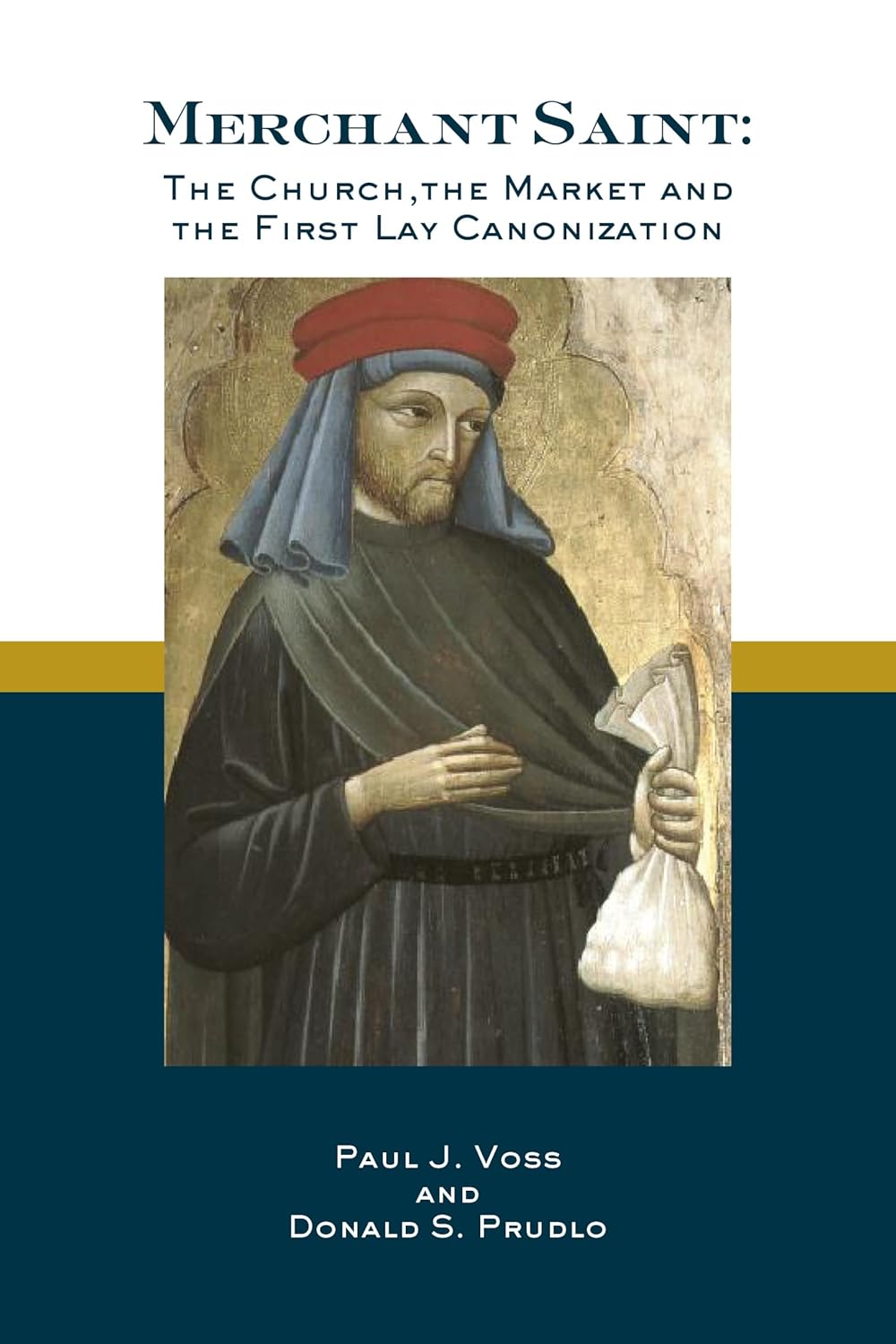
There are few figures who more directly challenge modern assumptions about the moral ambiguity of commerce than St. Omobono of Cremona. A merchant, husband, and citizen of a rising medieval city, he was also the first layman formally canonised by the Church. Paul Voss and Donald Prudlo’s Merchant Saint brings this largely forgotten figure back into view, and in doing so offers a striking meditation on whether economic life can itself be a genuine sphere of Christian virtue.
At first glance, the very idea of a ‘merchant saint’ appears paradoxical. The Christian tradition – especially in its early centuries – was often deeply suspicious of wealth, trade, and accumulation. The authors begin by carefully reconstructing this tension. Scriptural warnings against riches, patristic critiques of avarice, and the moral dangers of commerce form a powerful background against which Omobono’s life must be understood (pages 15–32). Wealth was not neutral; it was spiritually perilous. Yet, as the authors show, the tradition also developed a more nuanced account: riches could be redeemed through right use, particularly through almsgiving, which was increasingly understood in almost transactional terms – as a way of ‘storing treasure in heaven’ (pages 33–40).
It is precisely at this point of tension that Omobono emerges. Far from renouncing economic life, he inhabits it fully. A cloth merchant and artisan in the bustling commune of Cremona, he is neither monk nor ascetic outsider, but a man embedded in contracts, trade, and civic responsibility (pages 63–70). His sanctity does not consist in withdrawal from the market, but in a transformation of intention and practice within it. Prudlo and Voss are careful to stress that Omobono’s conversion did not abolish his economic activity; rather, it reoriented it. Property became the means of charity, profit the occasion for generosity, and work itself a field of moral discipline.
This is where the book makes its most significant contribution for contemporary readers. Omobono’s life suggests that commerce need not be morally neutral at best or corrupting at worst. Instead, it can become a site of virtue – provided it is governed by justice, honesty, and a recognition of the common good. The authors’ analysis of the early hagiographical sources is especially illuminating here. The evolution of Omobono’s vitae shows a gradual but decisive shift: from a model of piety centred on prayer and almsgiving to one that explicitly affirms the integrity of lay, economic life (pp. 120–135). The merchant is no longer merely tolerated; he is held up as exemplary.
The broader historical context reinforces this point. The twelfth and thirteenth centuries witnessed the rapid expansion of urban life, trade networks, and commercial practices. The Church could not simply condemn these developments without alienating the very fabric of emerging European society. Prudlo and Voss argue convincingly that figures like Omobono represent a kind of ‘medieval synthesis’ in which economic activity is neither sacralised nor rejected, but integrated into a wider moral and theological vision (pages 180–195). The market, as they memorably put it, begins to find its place on the ‘Christian map’ (pages 192).
For an audience concerned with the ethical foundations of markets, this is a crucial insight. Omobono does not anticipate modern capitalism, nor does he provide a blueprint for economic systems. But he does offer something arguably more fundamental: an account of the moral agent within economic life. The emphasis falls not on structures alone, but on character – on the virtues that shape how individuals engage in exchange, accumulation, and distribution.
The later chapters of the book extend this reflection by examining literary and cultural representations of merchants. Here the authors show that suspicion of commerce never fully disappears; the merchant often remains a morally ambiguous figure, associated with calculation, worldliness, and spiritual risk (pages 220–230). Against this backdrop, Omobono stands out all the more sharply. He embodies a counter-image: not the calculating trader, but the just and generous one; not the manipulator of value, but its steward.
If the book has a limitation, it lies in the fact that it stops just short of its own most important question. The authors offer a rich historical reconstruction and a compelling theological intuition – that economic life can be integrated into sanctity – but remains largely descriptive where a more explicitly normative account would be most fruitful. They show convincingly that such a reconciliation took place; they are less explicit about how it ought to guide economic life today. The internal norms of commerce – what distinguishes just profit from unjust gain, where the limits of accumulation lie, or how practices such as pricing, risk, and exchange are to be morally evaluated – are present only in outline. The reader is thus given a powerful figure, but not a fully articulated theory. One might say that Voss and Prudlo recover the merchant saint without quite developing a theology of the market adequate to his example. For a readership concerned with the moral foundations of economic life, this feels like a missed opportunity, especially since the material for such a development is clearly at hand.
Nevertheless, this is a minor reservation. The Merchant Saint succeeds admirably in recovering a figure who deserves far greater attention. More importantly, it reframes a question that remains urgent: whether economic life is merely a technical domain governed by efficiency and utility, or whether it can be ordered toward higher goods.
Omobono’s answer is quietly radical. Commerce, he suggests, need not be opposed to sanctity. Properly understood, it may even become one of its forms.
‘Merchant Saint: The Church, the Market, and the First Lay Canonization’ by Paul Voss and Donald Prudlo was published in 2025 by St. Augustine’s Press (ISBN 978-1-587-31513-8). 315 pp.