
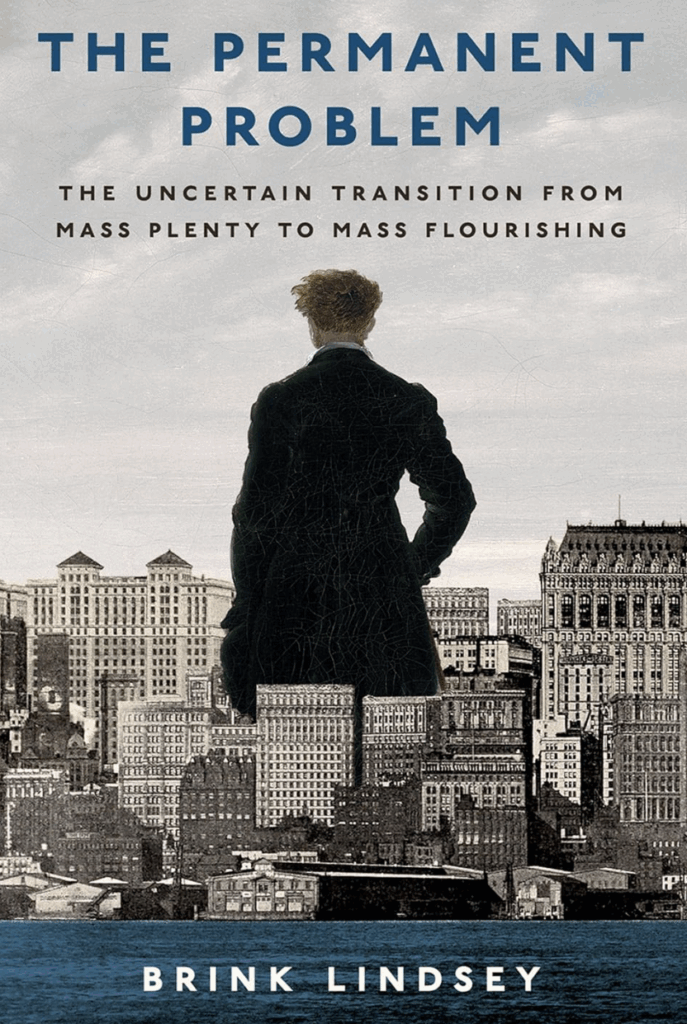
The central thesis of The Permanent Problem, by Brink Lindsey, is that we are living through an historic transition in which capitalism has delivered mass prosperity but has not yet worked out how to deliver mass flourishing (providing meaning, purpose, belonging, fulfilment). In addition, the author argues that the very forces that created mass abundance, are now undermining the social and cultural foundations that are required for a fulfilling life. So, in Lindsey’s view, capitalism has largely solved the problem of material scarcity, but it has not yet solved – and may be making harder – the deeper problem of human flourishing. In so doing, Lindsey sets out a series of epochs and epic transitions, from a world of scarcity to a modern world of mass abundance and a future world of mass flourishing. But Lindsey is not certain, or indeed confident, that the world of mass flourishing will be attained.
Throughout, Lindsey emphasises that capitalism has succeeded on multiple fronts historically, delivering unprecedented affluence, together with freedom, health, longevity and education. He readily acknowledges the extraordinary achievements of capitalism. But he then fears we have hit a wall, because he asserts that capitalism is not well designed to deliver meaning, status, identity and relationships. He argues that prosperity itself creates destabilising effects in the form of consumerism weakening deep relationships, individualism undermining social bonds, collapsing fertility, a deterioration in mental health and the fragmentation of communities.
In his view, this creates a mismatch between rising expectations and actual lived experience, as we move up the hierarchy of needs from material provision to deeper psychological desires. The knock-on effect of this mismatch is, according to Lindsey, essentially a triple crisis: (1) a crisis of dynamism – with slower productivity growth, innovation bottlenecks and regulatory and institutional drag; (2) a crisis of inclusion – a widening class divide, especially by education, entailing a breakdown of family, community and social cohesion; (3) a crisis of politics – falling trust in democracy, rising populism and institutional paralysis.
The problem becomes permanent in the sense that there will be no return to scarcity, but affluence continually generates new expectations, frustrations and forms of dissatisfaction. Lindsey argues that solving the material problem does not eliminate human problems, it merely transforms them. His broad conclusion is that we need to refocus (to restore dynamism and innovation and remove barriers to growth such as rent seeking and regulation) and restore (strengthen communities and shift some functions away from markets and the state, towards civil society and personal relationships) capitalism in order to translate material abundance into meaningful lives. Essentially, he is arguing that economic systems are good at producing means (wealth, goods and services) but human beings ultimately care about ends (purpose, belonging, identity, love).
This is a rich, and indeed powerful thesis, taking a broad conceptual sweep of history. But is it true, and how should one approach it from a Christian perspective? Lindsey acknowledges that he is not a believer. But his thesis might appeal to many Christians due to it: (a) placing deeper psychological and spiritual needs above material considerations; (b) asserting that materialism has undermined more important values; (c) focussing on inclusion and the fragmentation of society.
However, whilst recognising the many fascinating insights contained in the book, I’m deeply sceptical of the thesis of The Permanent Problem for a number of reasons:
First, because from the perspective of Christianity – and of other faiths too – the root problem is not material but spiritual. The challenges of the human condition were never primarily about prosperity and so that was never going to solve them. The Bible teaches us that human striving and achievement in the material world will fail to satisfy. That failure to satisfy is attributable to a God-shaped hole in people’s lives, and whilst it cannot be filled by material abundance, neither can it be filled by flourishing either, if that excludes God. Mass flourishing ultimately requires a great awakening. Secular flourishing will never be enough. In economic terms, there is an omitted variable in the permanent problem model, namely God.
Secondly, there is a need to focus on the ethical formation of individuals. Christians for example would express this by saying that human nature is distorted by the Fall. The problem therefore is not just a matter of institutions, such as capitalism. Instead of blaming the sinner, fallen man repeatedly blames the system. Whilst Lindsey clearly recognises capitalism’s role in prosperity, he ultimately still blames the system. But capitalism alone was never meant to deliver the flourishing that he seeks. That flourishing comes from placing wealth creation in its rightful context, seeking first His kingdom and His righteousness. That is the route to meaning, purpose, identity and fulfilment.
Thirdly, the problems it attributes to capitalism are more likely the fault of the state. The 1980s saw the Gordon Gecko ‘greed is good narrative’ take root in the media. But the idea that capitalism as a system is based on greed and rampant individualism is erroneous. Capitalism is a system of voluntary exchange to meet the need for goods and services. Without doubt, to the extent that the Judaeo-Christian ethic and worldview have been withdrawn from the public square, capitalism has become an uglier process, but the problem is surely too little God, not too much capitalism. Less inclusion and more fragmentation are more a consequence of secularisation, as the Leviathan state forces the good Samaritan off the road, and in so doing has undermined social capital.
Fourthly, the state is undermining the very prosperity Lindsey takes for granted. The idea that prosperity is done and dusted, and we can take it for granted, may prove a triumph of hope over experience. The economics literature clearly sets out negative trade-offs between the size of the state (measured in terms of tax and spend, regulation and public debt) and economic growth. Trend output growth – based on supply-side potential – in many of the advanced economies is around 1% less than that of only a few decades ago. Statism and an ageing population promise to reduce this growth rate even further over the coming decades, with the mother of all fiscal crises potentially waiting for us at the end. Lindsey correctly identifies, and argues well, the need for far greater dynamism. But I fear he understates the significance and scale of the required reduction in the size of the state in order to facilitate this dynamism.
The Permanent Problem is an excellent book. It is thought provoking and challenging throughout, but its fundamental flaw is the same for all such works – in attempting to represent reality without reference to God, it seeks an external solution to an internal problem. Lindsey recognises that secularisation has been part of the problem, but he seeks to find meaning and community within a secular society. He sees the problem as social and institutional, not spiritual, so his solution is worldly and pluralistic. Those of us who are committed to the Judaeo-Christian ethic will respond that it is the solution to the problem he identifies.