
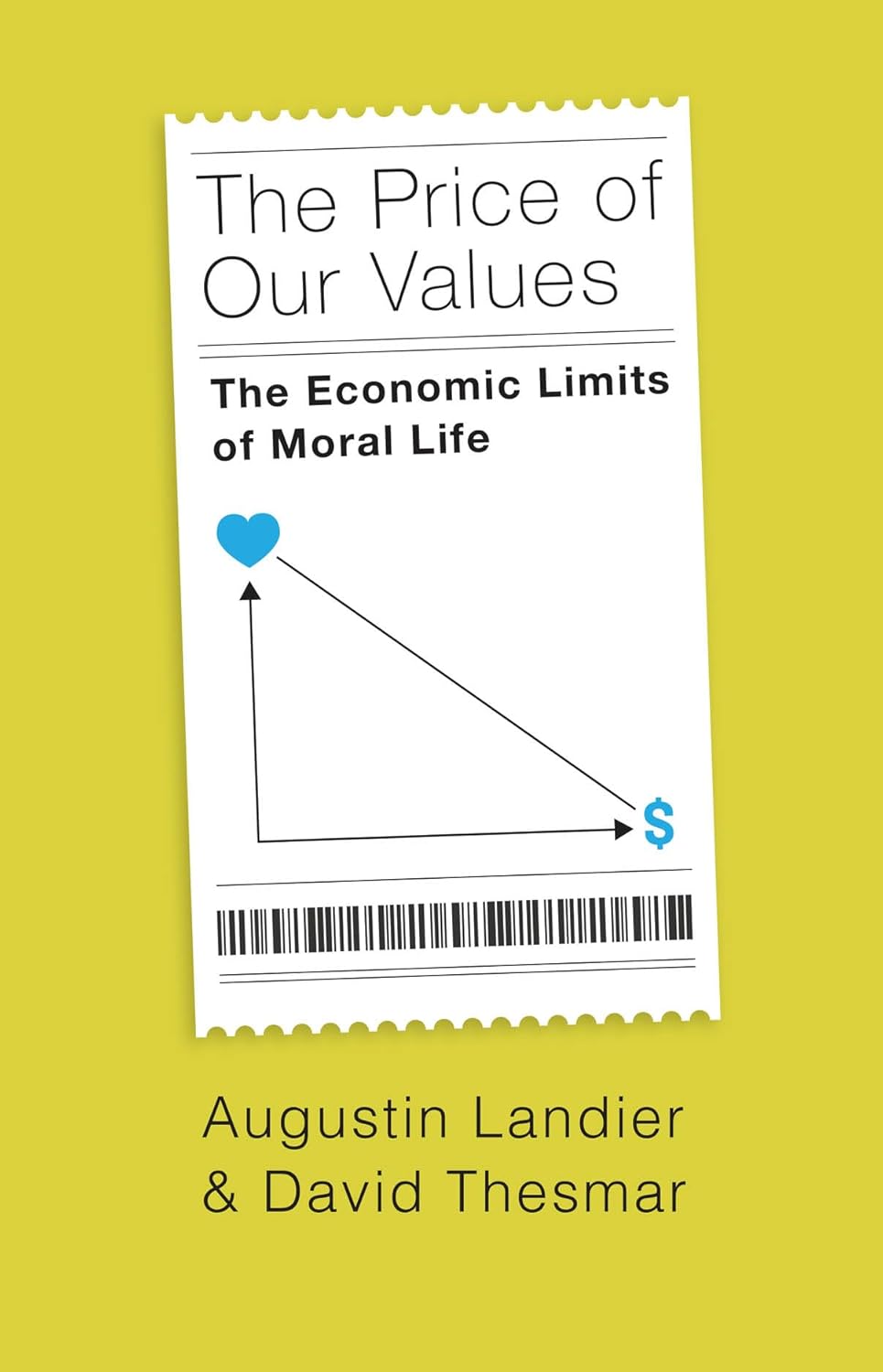
Written by two professors of finance (at HEC Paris and the MIT Sloan School of Management, respectively), this book considers the connection between economic thought and moral values, and the fact that they frequently come into conflict. Through a series of chapters on different issues, it focuses on the need for our moral decisions need to acknowledge their own costs – whether direct monetary costs, or simply the costs that arise in consequence of choosing one path over another – while economic analysis needs to acknowledge more fully the moral aspects inherent in any problem. This requires a willingness to include economic reflections in our moral thinking, but also a preparedness in economics to look beyond the default position of economic analysis – a utilitarian aggregation of pleasure, economic gain or material wellbeing – acknowledge its shortcomings and consider other moral perspectives.
The first two chapters set up the book, pointing out that we often separate economic thinking from moral thinking, as though economic thought has a corrupting influence on or no place in ethics. As the authors remind us, however, too often real life forces us to engage in both (for instance when deciding how to allocate resources in healthcare settings). They trace the emergence of utilitarianism as a central part of economic analysis, which, in its aggregation of ‘wellbeing’ or ‘pleasure’ also appears to make room for moral concerns, provided these are approached from a consequentialist perspective. Following a critique of utilitarianism, the book examines the shift in economic thought away from seeing people as self-interested and towards a recognition of altruism in human decision-making and policy-making. Nevertheless, the authors contend that in its treatment of ethics, economics still assumes a consequentialist outlook, continues to see human-beings as essentially selfish and views altruism as a form of universal or impartial utility-maximisation – all of which is open to question and does not appear to be supported by existing social scientific research into the ways in which people actually approach moral questions.
The point therefore emerges that greater recognition of ‘value pluralism’ is required: an acknowledgement that people do not typically think and behave as economics tends to assume, even when it takes account of moral considerations. As such, the authors state their intention of raising a series of dilemmas with a view to inviting readers to consider a range of responses, which draw on various philosophical positions beyond utilitarianism, as well as survey results, to show the trade-offs involved in each case and shed light on how people do in fact think.
Each subsequent chapter addresses a particular issue, covering liberty, competition and rents, justice, globalisation, cultural goods, companies and corporate virtue, and responsible investment. The treatment of each issue tends to differ. In some chapters, the authors outline a fairly characteristic approach from within economics and then subject it to criticism, showing that in their actual thinking, people do not tend to bear out the wisdom of the discipline but in fact have other legitimate concerns. For example, Chapter 6 examines the many reasons for which the population at large does not necessarily adhere to the general approach within mainstream economics that favours globalisation. This might not be because the public is simply bigoted or ignorant of the net benefits of free trade or migration, but because people have in mind not so much their own economic self-interest as concerns about socio-cultural and moral issues.
Other chapters, such as those on responsible investing or ‘beauty’, offer a more general discussion of relevant economic and non-economic considerations, and the trade-offs that have to be faced. Chapter 7, for instance, is concerned with cultural goods such as art and nature, and examines the ways in which we tend to view them not for their utility as consumption goods, but as having a value in their own right. This is a very interesting chapter that presents more in the way of philosophical discussion of our relationships with nature, heritage, science and the arts, closing with some reflections on possible cultural policy and the nature of the decisions that we might sensibly be expected to consider in relation to cultural goods.
This is not to say that chapters clearly follow one of two models but readers who begin the book expecting to find in each chapter a sustained discussion of ‘economic’ utilitarianism, deontological ethics and virtue ethics in relation to a specific issue, are likely to be disappointed. Instead, the book draws on these different approaches as they appear relevant to the direction of the discussion in hand. This approach does work but some might be of the view that this is not what they had come to expect from reading the introduction – but neither is the book a straightforward critique of the assumptions of economics. Indeed, the authors are keen to point out that they have themselves often argued for the positions that they subject to criticism – for instance in support of free trade – so in no sense is the work a rejection of the methods and models of economics as a discipline.
One or two chapters (particularly Chapter 5, on justice) probably attempt more than the space available allows, with the result that some of the discussions (such as the one on algorithms) are left somewhat short and leave the reader wondering what the purpose of their inclusion really is. Nevertheless, the book is clearly written in engaging prose and the purpose is clear: to call for ‘value pluralism’ in our consideration of important questions and to urge economic analysis to engage more fully than it currently does with the kinds of moral concerns that will often shape our thinking. This occupies more space in the book than the argument that our moral thinking needs to allow greater room for economic considerations, such that the subtitle (The Economic Limits of Moral Life) is arguably the wrong way round, but the book has much to recommend it. Importantly, in stressing ‘the need to understand and incorporate diverse perspectives on moral-economic trade-offs,’ the authors draw attention to the implications for public discourse. As they point out, such a ‘pluralistic approach acknowledges that different persons may prioritize different, yet equally legitimate, values, such as freedom, justice, tradition, or economic efficiency,’ adding that the ability to recognise ‘various moral perspectives on economic issues facilitates discussions about difficult choices’ (page 162). The book leaves open the question of how to balance these differing values and reach a consensus when they come into conflict or when policies are unpopular, but in calling for value pluralism, it represents a first step in making these conversations possible. It is certainly to be recommended to those interested in the relationship between economic analysis and moral reflection.
‘The Price of Our Values: The Economic Limits of Moral Life’ by Augustin Landier and David Thesmar was published in 2025 by The University of Chicago Press (978-0-226-82708-7). 191pp.

Neil Jordan is Senior Editor at the Centre for Enterprise, Markets and Ethics. For more information about Neil please click here.