
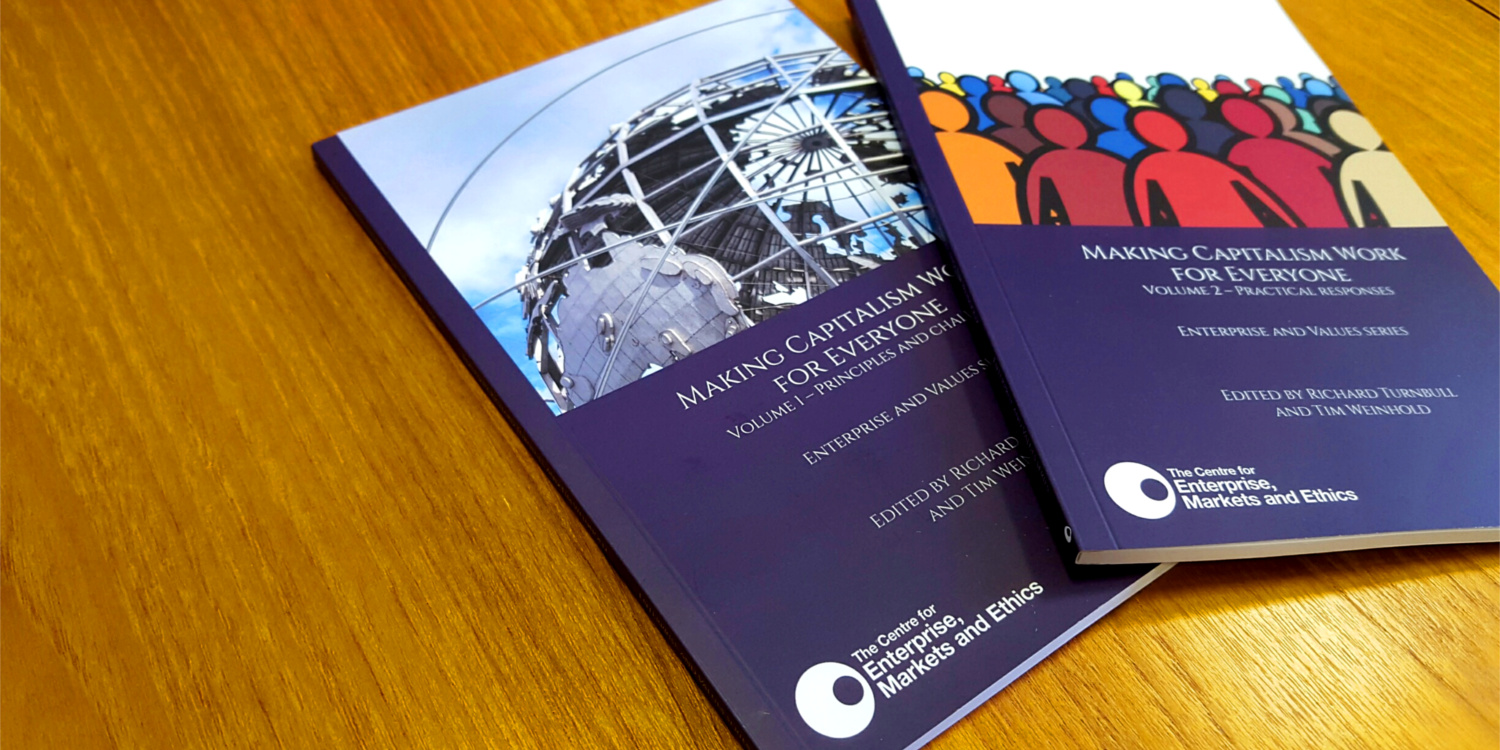
Chapter 2: Purpose, Practice and Partnership: A Christian Reflection
With apologies to Winston Churchill, it might be said that ‘Capitalism is the worst form of an economic system, except for all the others.’ Or putting it more positively, it seems beyond dispute that capitalism is the most efficient economic system for aligning the means of production with the desires of consumers (measured on a one-dollar-one-vote basis), but that this outcome is only one aspect of human flourishing.
The trouble comes when we forget this caveat. Often our idolatry of the free market leads us to conflate an efficient allocation system with an optimal overall societal outcome. Dazzled by the market’s many positive and amazing features, we quickly go blind to competing values. In the midst of our ecstatic worship of all the good that the market has done it becomes too easy to ignore the human and environmental damage it has inflicted along the way.
Indeed, it is the very success of the market that tempts us to idolatry. An increased reliance on market economics has led to rising standards of living in most places around the globe. Extreme poverty has been radically reduced. The world attained the first Millennium Development Goal target – to cut the 1990 poverty rate in half by 2015 – five years ahead of schedule largely through the introduction of market-based economies in Asia.[1] Reductions in the poverty rate continue in all regions. Huge gains have been made in reducing infant mortality and extending life spans. The number of neonatal deaths around the globe declined from 5.1 million in 1990 to 2.7 million in 2015.[2] Market forces have spurred on substantial growth in food production, in most cases sufficient to accommodate huge growth in the overall world population.
In addition there is credible evidence to support the assertion that respect for the ‘rule of law’ goes up as businesses operating in a capitalist environment are established.[3] The market has accomplished much good.
Yet it has also done much harm. It can fairly be held responsible for multiple instances of environmental degradation and cultural commodification. It has nurtured a temptation towards greed and created a corporate environment in which leaders are confronted with enormous temptations to ‘cross the line’ in pursuit of profits. In many cases it has turned a blind eye to slavery, forced labour and sex trafficking. Moreover it has aggravated the gap between the rich and the poor. According to Oxfam, from 1980 through 2012 the percentage of income held by the richest 1 per cent in the USA has grown nearly 150 per cent. That small elite has received 95 per cent of wealth created since 2009, after the financial crisis, while the bottom 90 per cent of Americans have become poorer.[4]
For at least the last 15 years, the School of Business and Economics (now the School of Business, Government and Economics) at Seattle Pacific University has been wrestling with questions of business and economics from a Christian perspective. Generally, the focus of these discussions has been from the perspective of the business leader; that is, what advice would the School offer a Christian in business who seeks to align his or her behaviour with God’s plans for the world? Under the broad heading of a ‘theology of business’, the School has been considering macro-level questions such as ‘How might God think about the appropriate purpose of business?’; ‘How might God want business as one institution in society to interact with other institutions?’; ‘How might God think about the free market system?’
Our conclusion is that business leaders need to attend to questions of purpose, practice and partnership. In so doing they can participate in God’s work in the world and help make capitalism work for everyone.
Purpose
In 2014, Miguel Padró, Senior Program Manager of the Business & Society Program for the Aspen Institute, released a paper entitled ‘Unrealized Potential: Misconceptions about Corporate Purpose and New Opportunities for Business Education’, which emerged from a series of Business & Society Program roundtables, meetings and private conversations with more than one hundred law and business scholars, corporate leaders and investors over the preceding three years. He wrote as follows:
While corporations are arguably the world’s most influential institutions, this influence is accompanied by deep public scepticism about the nature of the corporation, the motivations of its leadership, and its ability to advance the public good …
Such findings are sobering given the potential for our largest corporations to help solve the great challenges of our day, from developing and scaling clean energy to curing disease. Throughout history, the corporate form has been used for constructive and remarkably diverse purposes … However, an equally powerful narrative of the corporation views it as an engine of income inequality and a threat to the sustainability of our natural environment and the civic institutions charged with protecting society’s interests. Both of these narratives hold a fair share of truth and are deeply rooted in historical experience. And yet both assessments are incomplete on their own.
Conventional wisdom unnecessarily constrains thinking about the role of corporations in the long-term health of society …
The dominant conception today is that corporations exist to maximize value for shareholders. Unfortunately, a particularly narrow understanding of this paradigm leaves many MBAs believing that they are legally and morally obligated to maximize stock price for their investors. Over three years of dialogue among and with scholars, business practitioners, and investors, we have observed deep concern that such a view is not only untrue as a matter of law, but unwise as a practical business matter. Unfortunately, the narrow paradigm persists strongly throughout business education and surprisingly little new thinking about corporate purpose has emerged from the business academy for some time.[5]
Against this backdrop, an alternative understanding of business purpose is desperately needed if we are to make capitalism work for more than just investors. Indeed, I would argue that the good corporations can accomplish in our world will be substantially enhanced if the dominant paradigm is turned upside down.
At this point, most corporations would affirm the importance of offering employees opportunities to engage in meaningful and creative work and of developing products and services that will enable their communities to flourish. These ‘goals’, however, are really understood as strategies designed to help achieve the higher end of maximising returns on shareholder investment. Providing good jobs reduces turnover and keeps expenses down. Providing good products builds brand loyalty and increases sales. In each case, these strategies serve the higher purpose of greater profitability.
However, in the light of the biblical narrative, this model is indeed upside down. Instead of adopting maximising return on investment (ROI) as the ultimate corporate purpose, we concluded that businesses’ ultimate purpose would be better understood in terms of the following two goals:
1. Business exists to provide opportunities for individuals to express aspects of their identities in creative and meaningful work.
2. Business exists to provide goods and services that will enable the community to flourish.
I would argue that these are the proper first-order purposes of a business. Good profits – or ROI – is not the ultimate end of a business, rather it is the means of attracting the capital that the business needs in order to allow it to pursue its legitimate first-order purposes. Stated succinctly, profit is the means rather than the end of business operations.
Consider this metaphor: imagine that profit is like blood in our bodies. If you do not have blood circulating in your body we do not need to have a long discussion as to your purpose in life. You’re dead. Similarly if profit is not circulating in a business we don’t need to consider its purpose in society. It’s bankrupt. But which of us gets up in the morning and decides to dedicate our day to the ultimate purpose of pumping blood? No. Blood is critically important but it’s not the purpose of our lives. And the same is true of profit in business.[6]
The blood metaphor does highlight one other critical characteristic of profit, however. In addition to serving as a means to a higher end, it also operates as a constraint. When a business leader sets out to achieve the twin goals of good jobs and good products, he or she cannot choose from any option that might advance these ends. Rather he or she must limit the options under consideration to those that can be pursued profitably. And in many contexts, this can be very limiting indeed.
Still under this proposed upside-down paradigm, the question to be pursued when making a strategic business decision is fundamentally different. Instead of asking which of the available options will most likely maximise ROI, the first question should be ‘Which option can I pursue that will go the farthest towards creating opportunities for meaningful and creative work and providing the products and services most likely to enable my community to flourish?’ These are fundamentally different questions and over time they will lead in different directions.
Practice
To understand a game one needs to have a clear understanding of both the object of the game (i.e. what it takes to win) and the rules (the limits of what you can do as you pursue the object). In the same fashion, reflecting on the discipline of business from a biblical perspective, if we are to understand God’s design we will need a clear understanding of both the object – the purpose of the work – and an understanding of the ‘rules’ that a business leader should respect even as he or she pursues the purpose.
Put differently, the question is one of limits and boundary conditions. What limits should a business respect as it pursues the twin first-order purposes of good jobs and good products/services?
Just as there currently is a dominant understanding of business purpose – that is, maximising returns on shareholders’ investments – there is also a conventional understanding of business limits. Put simply, under at least one school of thought, a business leader has a fiduciary duty to do everything possible to optimise ROI so long as it does not involve breaking the law.
But does that mean it’s all right for CEOs to maximise profits by following perfectly legal business practices that cross the line into unethical waters? Some business executives would say ‘yes’. Their stance is that a CEO’s main responsibility is to maximise profits and shareholder value within legal parameters – even if that means having low ethical standards:
… just because a decision may be viewed as ruthless, doesn’t mean it’s the wrong choice for the long-term viability of the organization. When it comes to the game of business, my rule is to know the rules and then play the game at the very edge.[7]
A competing view requires that business decisions be limited by both legal and ethical constraints. But even here, the understanding of ethics is often impoverished. For some, the two are conflated. For example, ‘”If it’s legal, it’s ethical” is a frequently heard slogan.’[8] For others, ethics may go beyond the law – but not too far. The patron saint of the ‘maximise ROI’ understanding of purpose, Dr Milton Friedman, explains the limitation this way in his seminal article, ‘The Social Responsibility of a Business is to Increase its Profits’:
The responsibility is to conduct the business … to make as much money as possible while conforming to the basic rules of society, both those embodied in law and those embodied in ethical custom.[9]
While this seems to open the door to some restraints beyond just legal requirements, the balance of Friedman’s article reveals how narrow this ‘expansion’ really is:
There is one and only one social responsibility of business – to use its resources and engage in activities designed to increase its profits so long as it stays within the rules of the game, which is to say, engages in open and free competition without deception or fraud.[10]
In short, for many, the dominant view holds that business choices are limited to law with perhaps a dash of ethics thrown in. From a Christian perspective, however, this is unsatisfactory. Christians are to aspire to be like God ‘in true righteousness and holiness’ (Ephesians 4.24), and while compliance with laws may, in most instances, serve as a floor for righteous behaviour it is certainly not the ceiling. So beyond mere compliance with laws, what additional ethical limits or boundary conditions should a business respect?
Of course, there are a number of sources for authority that one might refer to in answering this question. Biblically, however, I would suggest that there are two overarching principles that together capture God’s higher standards for ethical limits. Both are derived from the biblical Creation account. As originally designed by God, human beings were made in the image of God (Genesis 1.27) and were called to function as God’s stewards who would guard or take care of their environment (Genesis 2.15). Consequently, Christians in business have a duty to respect each individual as God’s image bearer and a duty to operate their businesses in a sustainable fashion.
A duty to respect each individual’s dignity in business dealings is relatively easy to understand, albeit sometimes difficult to put into practice. It involves encounters with individuals in every dimension of the business, such as customers, employees, colleagues and vendors. It implicates, among others, issues of integrity, privacy, freedom of expression, sexual harassment, racism, sexism, fair working conditions and reasonable pay. In each case the question to be asked is whether a contemplated business decision will honour the image of God in each individual who will be impacted by the decision.
Sustainability takes a little more explanation. Although this isn’t perfect (for example, it doesn’t work particularly well for businesses in extractive industries), ‘sustainability’ might be assessed by asking the following question: ‘If nothing changed in the external surroundings of a business, could it continue to practise business in this way for ever or, alternatively, is it using something up such that when it is gone, the business will have to change?’
In the USA, references to ‘sustainability’ are typically understood in terms of the natural environment, and certainly this is included. However, the concept has applicability across all dimensions of the business. Will the practice in question be sustainable in reference to shareholders? Employees? Vendors? Customers? And so on. For each of these stakeholders, principles of sustainability can be developed. For example, this is why a business must pay a risk-adjusted rate of return on invested shareholder’s capital – not because doing so is the purpose of the business but because to do otherwise would be unsustainable. The business would burn through the invested capital with no opportunity to replenish.
Similarly, with respect to employees the principle of sustainability suggests that Christians should be at the leading edge of the ‘living-wage’ movement in the USA. For a business to use up the entire productive capacity of an individual but to fail to pay him or her an amount sufficient to survive on is fundamentally not sustainable. Comparable principles could be developed for the other categories of stakeholders.
The first-order purpose of business is to serve in two key dimensions: by providing goods and services that will enable the community to flourish and by providing opportunities for individuals to express aspects of their identities in meaningful and creative work. As businesses pursue these goals, however, they must select from the universe of possible choices only those that can be pursued in a manner that respects the dignity of each individual involved and is sustainable across all dimensions of the business.
Partnership
The institution of business was never intended to function in a vacuum. In God’s design, business was intended to work in partnership with other institutions to enhance ‘the common good’. Business and other institutions were to be allies working for a common purpose rather than adversaries pursuing competing interests. While this applies to many different institutions, the relationship between business and government deserves special attention.
Notwithstanding a handful of public–private initiatives, most people in business and government experience the relationship between these institutions in adversarial terms. Government often approaches business as a wild animal that desperately needs to be controlled. To tame the beast it passes more and more laws and regulates business activities more and more closely. In its preoccupation with avoiding harm it frequently tramples on the important work of businesses as wealth creators. At its worst, it can substitute the judgement of politically motivated decision-makers in situations where attending to market signals would yield decisions more likely to nurture human flourishing.
At the same time, however, business frequently disrespects the role of government. Government involvement is characterised as a costly nuisance and distortion. Government bureaucracies are mocked as cesspools of inefficiency and its intrusions into the marketplace are to be resisted, subverted and avoided if at all possible.
Of course, neither of these positions honours the God-given purpose for government and for business. Neither was intended to function alone. Each needs the other. Government needs business. By itself it can never improve the overall financial health of its constituents. It needs business to create wealth and provide jobs. Moreover, government funds its operations from tax revenues – revenues only produced directly or indirectly by businesses.
However, business desperately needs government if it is to function in a manner that enhances the common good. In some ways this is obvious. Business needs laws and courts to enforce contracts. Businesses need police and firefighters to protect their facilities. They depend on government to provide the physical infrastructure, such as roads, needed to facilitate commerce, and to fund the basic research that is often the wellspring of new innovation but too risky and costly for any one business to undertake.
Business also needs government to help ensure that the market functions appropriately. It is the government that enforces antitrust laws to prevent monopoly power from distorting the market. Government regulations capture externalities that individual businesses have incentives to avoid but which, once captured, allow the market to function more accurately. Governments require businesses to provide information that allows customers and investors to make better market decisions.
Government can help level the playing field between businesses by ensuring that they abide by a common set of ground rules. In some ways, the more ethical the business, the greater its appreciation for government regulation that forces its less ethical competitors to operate within a comparable cost structure.
When Alan Greenspan was questioned in the wake of the subprime mortgage meltdown about his previous opposition to government regulation of the financial industry, he noted: ‘I made a mistake in presuming that the self-interest of organisations, specifically banks, is such that they were best capable of protecting shareholders and equity in the firms.’[11] It seems that government regulation is necessary, at times, just to preserve the health of the business.
Society’s common good requires that goods and resources be fairly distributed. Fair distribution invokes two values that coexist in tension: distributing goods in respect of merit; and distributing goods equally. Merit-based distributions reward individuals for their ingenuity. They provide incentives for risk-taking and hard work. By and large, the market is a merit-based distribution mechanism. Government, by contrast, tends to function within a framework of equality.
Both are needed. Business creates wealth but, left to its own devices, will tend to distribute the wealth unevenly. Much of the growing income inequality that exists in our world today can be traced to this phenomenon. Government, on the other hand, does not create wealth but facilitates its redistribution in a way that is designed to enhance equality. It does so through a variety of mechanisms including enforcement of labour laws, setting a minimum wage and enacting progressive taxation structures. Society flourishes best when there is a healthy balance between merit-based and equality-based distributions, and neither government nor business acting alone can achieve this balance.
So what might this mean for a Christian in business?
In general the business person should interact with government as an ally in pursuit of the common goal of human flourishing rather than as an adversary. This change in perspective alone will open up significant opportunities for partnership.
Business leaders should resist evaluating government in reference to business metrics. Efficiency is a central value of business. The capacity to produce more with less directly contributes to the business goal of wealth creation – providing goods and services that will enable the community to flourish. And, of course, there is no inherent value in an inefficient government. But government operates on a different ethic. Its goals and purposes are advanced through a political process of broad inclusion and compromise. These processes are inherently inefficient and yet central to government’s vocation. It undercuts government’s purpose when its output is critiqued against business standards.
In some cases, Christians in business should support the enactment of regulations that would require all competitors to comply with a certain set of ethical standards. For the Christian in business who would be complying with these ethical standards in any event, regulation may help level the playing field. Of course, the desire to level the playing field must be weighed against the inevitable transaction costs of enforcement, reporting and monitoring compliance with new regulations, the reality that all regulations are inherently both over- and under-inclusive, and the risk of unintended consequences. It also must take into account the very real possibility that in the context of globalisation, a competitor may simply move to another jurisdiction.
Christians in business should avoid using government to secure a competitive advantage in the marketplace. In his book Supercapitalism, Robert Reich describes a number of ways businesses have leveraged their political contributions to secure regulations that afford them an advantage over others in their industry.[12] In effect, these are cases where regulations are not being used to level the playing field but rather to tilt it in favour of the politically well-connected. This thwarts government’s purpose of looking out for the welfare of all and undermines its capacity to partner for the common good.
Business leaders operating within a regulatory structure will occasionally find gaps in the legal scaffolding. Conventional wisdom suggests that these are opportunities to be taken advantage of. But where the gap is clearly unintended or, as is sometimes the case in developing world countries, a function of a weak government, the business should work to strengthen the underlying regulatory scheme rather than take advantage of it in a way that would undermine the government’s intentions.
In short, business needs government and government needs business. And society needs both of them to function as allies if they are to pursue the common good.
Conclusion
If business is to seek the common good – indeed if it is to work for everyone – it must redirect its efforts away from a narrow focus on maximising ROI towards business choices that will seek to profitably create meaningful jobs and good products. It must conduct its operations in ways that respect the fundamental dignity of each individual it touches and are sustainable across all of its stakeholders. And it must be willing to partner with government and other institutions in society, recognising that the common good depends on a set of institutions, serving different but complementary goals, working in tandem.
Notes to Chapter 2
[1] United Nations, ‘The Millennium Development Goals Report 2012’, New York: United Nations, 2012, p. 7.
[2] ‘Children: Reducing Mortality – Fact Sheet’, World Health Organization, last modified September 2016; www.who.int/mediacentre/factsheets/fs178/en.
[3] Ann Bernstein, The Case for Business in Developing Economies, Johannesburg: Penguin Global, 2010, pp. 190–209.
[4] Ricardo Fuentes-Nieva and Nick Galasso, ‘Working for the Few, Political Capture and Economic Inequality’, Oxfam International; www.oxfam.org/sites/www.oxfam.org/files/bp-working-for-few-political-capture-economic-inequality-200114-summ-en.pdf.
[5] Miguel Padró, ‘Unrealized Potential: Misconceptions About Corporate Purpose and New Opportunities for Business Education’, working paper of the Aspen Institute Business & Society Program, 2014, pp. 2–3.
[6] Don Flow, interview by Al Erisman, Ethix, 1 April 2004; http://ethix.org/2004/04/01/ethics-at-flow-automotive.
[7] Raquel Baldelomar, ‘Where is the Line between Ethical and Legal?’, Forbes, 21 July 2016, emphasis added; www.forbes.com/sites/raquelbaldelomar/2016/07/21/where-is-the-line-between-what-is-ethical-and-legal/.
[8] Lynn S. Paine, ‘Managing for Organizational Integrity’, Harvard Business Review, March–April 1994, p. 106.
[9] Milton Friedman, ‘The Social Responsibility of Business is to Increase Its Profits’, The New York Times Magazine, September 1970, pp. 122–6, at p. 122.
[10] Friedman, ‘Social Responsibility’, p. 126.
[11] Alan Beattie and James Politi, ‘”I made a mistake,” admits Greenspan’, Financial Times, 23 October 2008; www.ft.com/content/aee9e3a2-a11f-11dd-82fd-000077b07658.
[12] Robert B. Reich, Supercapitalism: The Transformation of Business, Democracy and Everyday Life, New York: Vintage Books, 2007, pp. 131–67.