
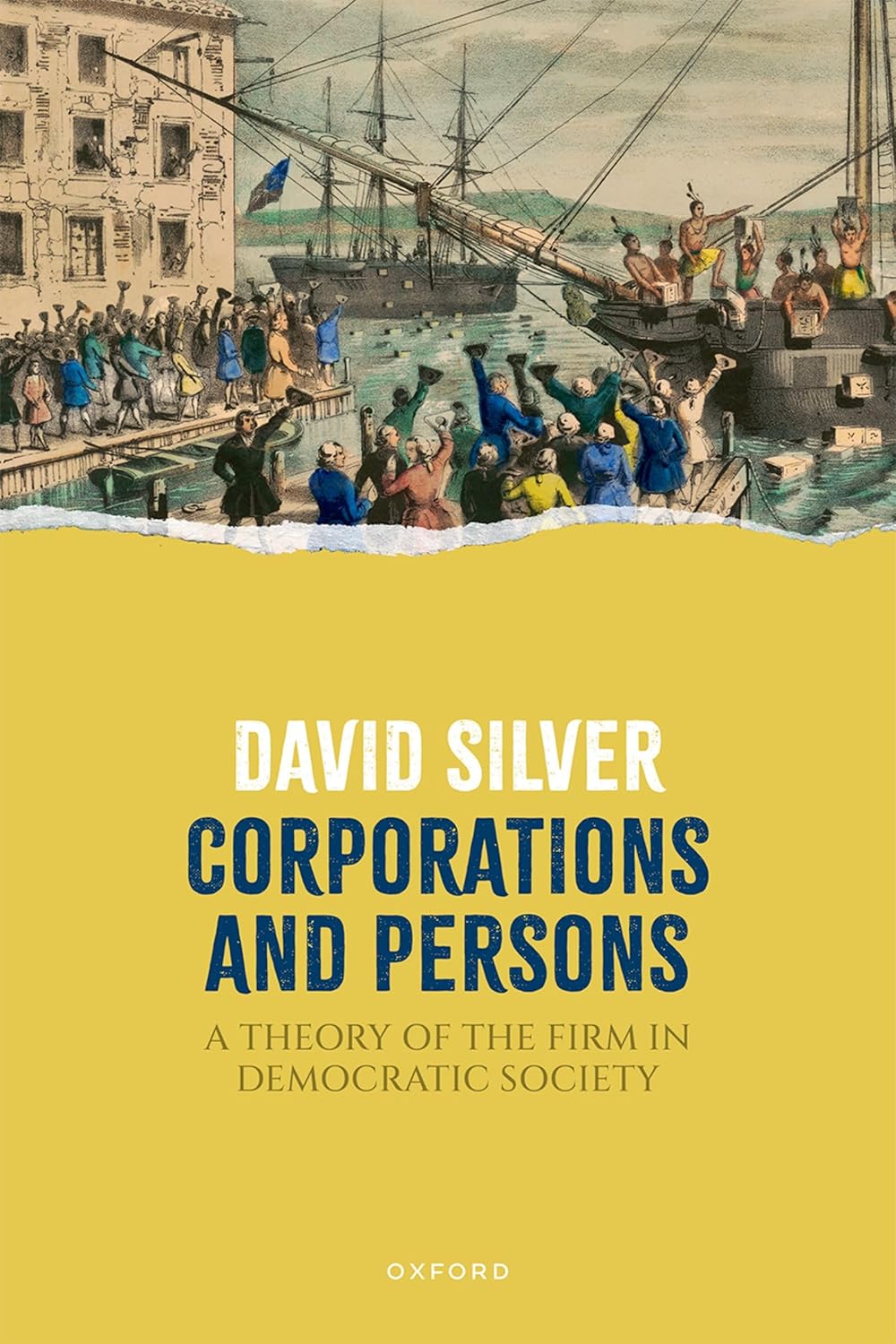
Corporations and Persons is not for the casual reader: the first half comprises a dense and highly contentious examination of the nature of personhood and moral responsibility and the second half includes a torrent of assertions relating to alleged duties of corporations which requires slow and careful consideration.
That said, the book deals with important issues. David Silver argues that ‘the corporation is … a kind of person in moral relationship with human beings, and in particular with democratic society’ (page 1). He thus considers that corporations have moral responsibilities and, ‘in a certain abstract sense’ (page 5), moral rights and he seeks to describe these responsibilities and rights. Unsurprisingly, he considers the acceptance of his thesis to be important, stating ‘I have written this book to urge all of us to adopt an understanding of the relationship between corporations and the rest of democratic society which is grounded in a commitment to liberal democratic values’ (page 186).
Silver rejects ‘the idea that we have theoretical intuitions which directly provide us with knowledge of the nature of moral responsibility’ (page 12) but his view of such responsibility is nonetheless ultimately subjective. He refers to our ‘reactive attitudes’, which he describes as ‘a family of mental states which includes blame, resentment, gratitude, indignation, and appreciation’ (page 11) and he goes on to assert that ‘we should understand our theoretical intuitions about moral responsibility as arising out of our efforts to make sense of our reactive attitudes, and then judge their validity insofar as they accurately make sense of them’ (page 12). It is thus ultimately on the basis of our ‘reactive attitudes’ that he concludes that corporations have moral responsibilities.
He recognises that he is dealing with ‘age-old questions’ of philosophy (page 9) and he seeks to deal with a number of modern objections to his theories. However, although some of what he says is powerful, it does not dislodge the most serious objections. In particular, Christians and other monotheists must surely start with a concept of morality that relates to God: to say that someone has a moral duty is to say that they are accountable to God in respect of their behaviour. The implication of this is that only sentient beings can have moral responsibilities and, since corporations are not sentient (a fact that Silver accepts [page 4]), they cannot have such responsibilities. In this connection, it is interesting that Silver himself slips into using language about corporations that implies sentience (e.g. ‘corporations can have a messy set of dispositions towards their moral obligations’ [page 20]).
Quite apart from theistic arguments, contrary to Silver’s view, David Shoemaker is surely right to assert that corporations (in contrast to their directors and managers) ‘cannot be sensible targets of angry blame’ (page 17). To say that a corporation ought to have done something is no more than a shorthand way of saying that those running the corporation ought to have ensured that the relevant thing was done. Anger is only meaningfully directed at them. Anyone who doubts this should imagine a situation in which a corporation has no directors or managers and ask whether they could meaningfully be angry with it.
Silver accepts the existence of objective value and thus objective morality and he centres the latter in ‘the intrinsic value of human beings qua sentient person’ (page 45). Such a starting point may well lead to conclusions similar to those that Christians draw from the idea that human beings are made in the image of God. However, on its own, it leads to an entirely human centred morality which is rather narrower than a morality that starts with God’s creation and care of all things and the notion of responsibility to God. Furthermore, Silver goes on to state that his theory ‘analyzes the world in terms of how to create the greatest level of rational self-governance that can be made available to each person in society’ (page 46; emphasis Silver’s), which elevates self-governance from being a relevant consideration to a central position that is potentially dangerous and is certainly contrary to a monotheistic view of the world.
On the basis of his theories of personhood and morality, Silver seeks to establish the purpose of corporations, which he believe is ‘to create products and services that provide a benefit to those who ultimately use them’ (page 63). He then moves on to describe a large number of duties that he believes corporations owe (25 of varying levels of specificity are listed on page 174) and a lesser number of rights that he believes they enjoy. His view of purpose is contentious but not new and there are books that argue for similar purposes in more detail (e.g. the books by Colin Mayer reviewed on this website). Likewise, there is little new in the duties and rights that he advocates, although this is not to say that they are either uncontentious or even clear. Indeed, many of the alleged duties, as listed on page 174, are not adequately backed up by argument and many of them are vague (e.g. the assertions that corporations should not seek more than their ‘fair share of attention from policy makers’ [page 155]).
Much more seriously, there appears to be a fundamental conflict between, on the one hand, Silver’s reaction to the divergence between his views and the laws of the USA and, on the other hand, his stated commitment to the upholding of democracy. This conflict is most evident in relation to corporate purpose. Silver’s view is, of course, out of line with the law of the State of Delaware (where a large proportion of major US corporations are incorporated), which requires that corporations focus, at least primarily, on the pursuit of profit. At one point, Silver appears to accept that Delaware law inevitably trumps his view: he says that ‘It is up to each democratic society to make its own determination regarding the purpose of the firm’ (page 53). Indeed, he goes further, saying that ‘democratic citizens have the prerogative to institute a system of democratic social governance, which assigns moral and legal rights and duties to individuals and institutions’ (page 54; emphasis Silver’s), which is a truly extraordinary statement in so far as it asserts that morality is determined by the state! However, at the same time, Silver argues for civil disobedience by the managers of Delaware corporations (i.e. non-compliance with the Delaware law relating to corporate purpose [pages 96-99]). How does he reconcile these statements?
The answer is: by characterising the relevant Delaware law as ‘authoritarian’ and ‘undemocratic’. He says that ‘I call a social decision-making process authoritarian if it does not track the values and judgments of the people it affects’ (page 91) and, having stated that ‘interstate competition for corporations is an authoritarian force’, he concludes that ‘to the extent that Delaware’s corporate code posits a legal duty to maximise profits, this lacks democratic legitimacy’ (page 93). This in turn leads to the conclusion that ‘non-compliance [by managers with that legal duty] can be justified given that the law’s understanding of their duties was generated in an authoritarian manner’ (page 98).
This is breathtaking! He simply redefines the word authoritarian so as to include, and the word democratic so as to exclude, things that he does not like. Delaware’s laws may be undesirable, even unethical, but they are constitutional, established through the democratic process and not authoritarian, using these words in their normal senses. Furthermore, leaving aside the linguistic sleight of hand, if a democratic society is to survive, the bar for civil disobedience must be set far higher than Silver suggests.
Silver uses the same technique to attack court decisions that he does not like, including both cases upholding and interpreting the Delaware laws that he dislikes and the much debated Citizens United case, in which the US Supreme Court overturned laws restricting political spending by corporations. He describes the latter as ‘highly antidemocratic’ (page 115) and, at one level, he has a point in relation to this: the role of the US Supreme Court has the effect of transferring power from the legislatures of the USA to the courts. However, while this may or may not be desirable, it is the consequence of the US constitution, which is itself a democratically adopted and amendable instrument. Furthermore, the nature of a Supreme Court decision (i.e. whether or not it is antidemocractic) cannot possibly turn on whether or not it determines that a particular matter is or is not in breach of that constitution.
The strangest thing about Silver’s book is the fact that he could have argued in favour of the duties (and indeed rights) that he discusses in the second half of the book without the need to argue that corporations are morally responsible persons. For example, he could have argued in favour of his view of the purpose of corporations by arguing that their managers have a duty to pursue this purpose. Indeed, as the book progresses, Silver talks more and more about managers and, even human beings in general. In particular, he recognises that the question of civil disobedience is, in reality, a question of the conflict between what he sees as the moral duties of the managers of corporations and their legal duties. He also acknowledges that many of the duties he asserts are duties applicable to all people and his comments about democratic legitimacy are clearly independent of the philosophical issues that he has considered earlier in the book.
This contributes to the impression that Silver may have an agenda that goes beyond that which is the book’s stated purpose or at least a desire to appeal to a particular audience: at several points, there are passing references to stock issues that suggest virtue signalling (e.g. there is a short paragraph on page 49 that crams references to ‘racial and ethnic minorities’,’ indigenous peoples’ and ‘people with nontraditional genders and sexual orientations’ into a few lines); his comments on the Citizens United case include the statement that the decision ‘reflected … close personal connections between the national political and industrial elites, and perhaps a new understanding of their shared class interests’ (page 115); he asserts (without argument) a duty ‘to develop an historical awareness of … the ways that the history of capitalism is intertwined with the history of colonialism, racial oppression, and slavery’ (page 167); and the main part of the book ends with criticism of the repeal of the provisions of the US Glass-Steagall legislation that, in essence, required the separation of commercial and investment banking, an attack on the suggestion that misguided government policy relating to lending to minorities was a cause of the Global Financial Crisis, an attack on the ‘unfair’ response of the US Government to the crisis, and statements relating to the duties of corporations in respect of climate change – all in the space of just over two pages (pages 176-178)!
The book raises important issues but it is deeply flawed. The examination of the philosophical issues in its first few chapters is worthy of study, albeit with considerable care. However, those wishing to consider in detail the duties of corporations and their managers would be better off looking elsewhere.
‘Corporations and Persons: A Theory of the Firm in Democratic Society’ by David Silver was published in 2025 by Oxford University Press (978-0-198-94068-5). 189pp.

Richard Godden is a Lawyer and a Consultant of Linklaters. He was a Partner of Linklaters for 36 years during which time he advised on a wide range of transactions and issues in various parts of the world.
Richard’s experience includes his time as Secretary of the UK Takeover Panel and later as a member of its rule making committee. He also served as Global Head of Client Sectors, responsible for Linklaters’ industry sector groups, and was a member of its Global Executive Committee.
He has been the chair of the CEME board since 2023.