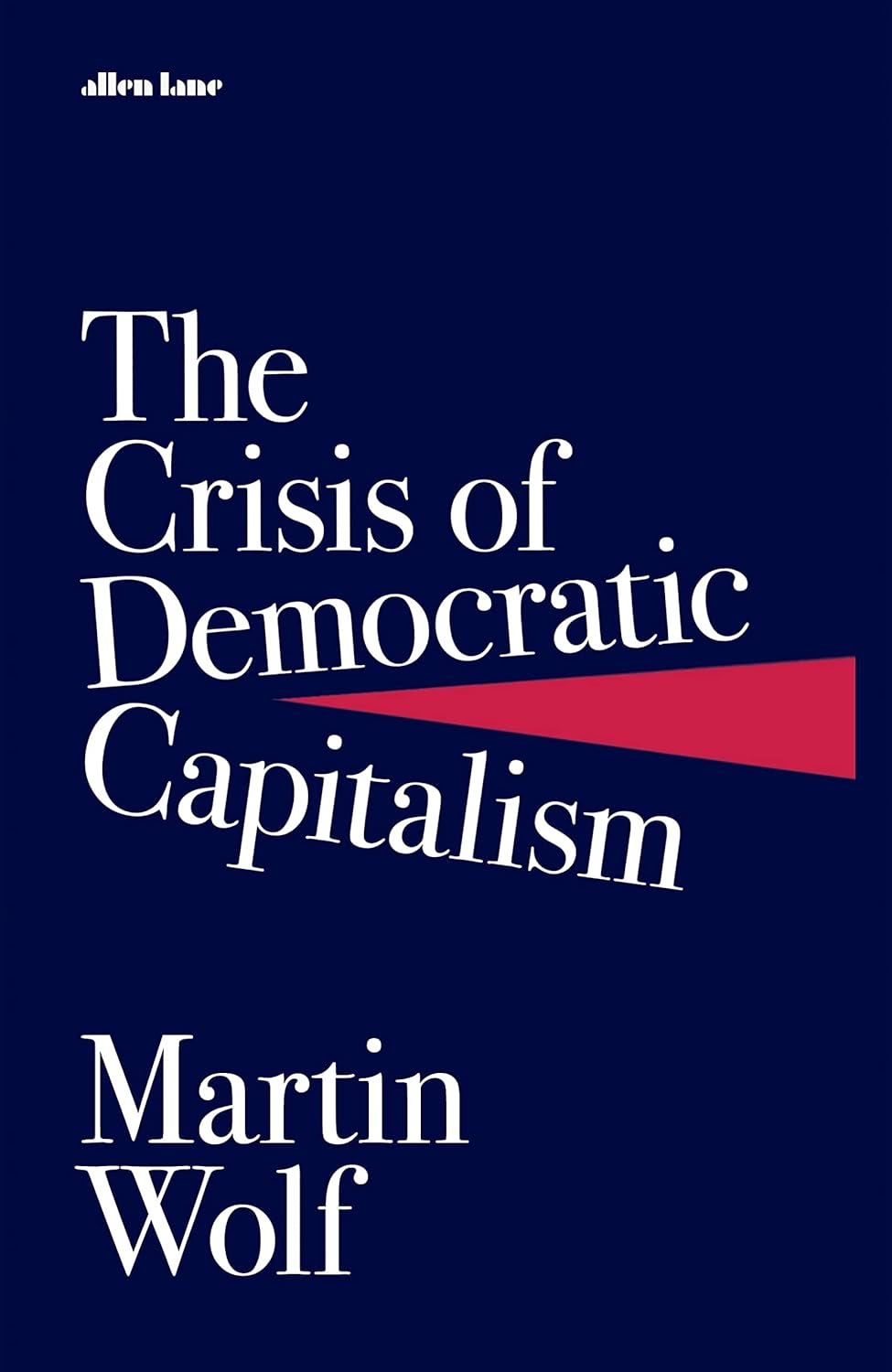
Scholars ranging from Milton Friedman to Paul Krugman have argued that liberal democracy and market capitalism are ‘symbiotic twins’: each requires the other. Yet there is increasingly a sense that the relation is becoming abusive. Martin Wolf sees a crisis, and his diagnosis is sweeping and urgent: elites must reform the system, and soon, before it collapses.
But Wolf’s prescriptions depend on cooperation, or at a minimum consent, from the very elites he sees as causing the crisis in the first place. This is a common problem in ‘Public Choice’ analysis, the part of political economy where this reviewer works. Systemic problems need not reflect any irrational or mistaken behavior on the part of actors in the system. Appallingly, it is precisely the self-interested, narrowly ‘rational’ choices being made by those with the power to effect change that ensure that change will be difficult.
Wolf brings together political theory, growth and distribution data, financial history, and current events to explain how shocks (financialization, the global trade and technology wave, and social media dynamics) weakened the democratic-capitalist symbiosis. The book is well-reasoned, but fails (in this reviewer’s opinion) to understand the pathology of the codependence between capitalism and democracy.
Wolf’s account focuses on what he calls ‘pluto-populism’, which he sees as having four main features. The first is ‘pseudo-populist rhetoric,’ where super wealthy candidates or their pet parties publicly adopt populist language—though likely not policies—blasting corrupt elites and presenting themselves as the only possible saviors of the interests of ‘the people’. The second is plutocratic policy priorities once those parties gain office. They cut social program spending, and slash taxes and regulations that constrain the wealthiest segments of society: Once in power, the policies enacted serve the interests of the extremely rich.
The third feature is a ‘bait and switch’: to cover the betrayal on economic policies, pluto-partisans inflame cultural grievances by focusing on immigrants, minorities, or (in the U.S., in particular) out-of-touch university faculties and Hollywood stuffed shirts. Fourth, and ultimately most dangerously, the pluto-partisans actively weaken democratic institutions, because they know their ersatz populist rhetoric cannot permanently disguise their self-serving policy choices. Again, from a U.S.-centered perspective, this would mean extreme gerrymandering, and dismantling restrictions on torrents of money entering and influencing politics.
It is hard to tell if Wolf thinks this is a particular, historically contingent, empirical description of the process or if he believes the problem is inherent in demo-capitalist systems. I agree with his view that only liberal democracy reconciles efficiency with personal freedom and accountability. This is an important counterweight to calls, from the left and the right, to sacrifice liberal democracy to address the crisis.
One might note that, even if one accepts the merits of Wolf’s claims, there are blinders for some important outside ‘shocks’ in the recent period. The rise of China as a global economic superpower, the expansion of social media in politics in ways that don’t even require money, and the disruptive forces resulting from artificial intelligence, have all destabilized the system. The fact that there is political and economic chaos need not lead us to infer that a cabal of super-rich Bond villains are controlling and directing the process behind the scenes.
That said, the broad strokes of the crisis portrait painted by Wolf ring true. But in agreeing with that diagnosis, this reviewer is much less persuaded by Wolf’s prescription. His ‘solution’ is the usual progressive dog’s breakfast of aggressive industrial policy, antitrust, forcible takeover of corporate governance, stronger social insurance and place-based support, more effective public administration, and insulation of democratic institutions from outside influence, especially real political campaigns where money can be spent to level the pitch against concentrated government power.
Look: the reason there is too much ‘money in politics’ is that there is far too much politics in money. Constitutional restrictions on the ability to take, manipulate, and redistribute wealth would be more effective in separating economic power from political power, and more supportive of democratic institutions. Giving property rights the same status as political rights would separate the two spheres more effectively, and with better results. However, that ‘solution’ would require that elites in Congress give up the lucrative right to be corrupted, and that elites in the corporate world give up the right to do the corrupting. Even though the solution is simple, it is not easy.
A recent book by Ruchir Sharma, What Went Wrong With Capitalism? (Munger review, CEME review) is instructive in this regard. Sharma notes that the story of ‘austerity’ and cuts in social programs—a story Wolf embraces—is entirely fabricated. In fact, government spending has gone up steadily, in real terms, per capita, and as a proportion of GDP. There have not been cuts in social spending; the ‘cuts’ have only been reductions in the anticipated rates of increase. Austerity is, in short, a myth: government spending has grown steadily, and mostly on a straight trend, since 1960.
As a result, Sharma contends, productivity has slowed, inequality has widened, and economies are increasingly dominated by large, entrenched firms (oligopolies or ‘zombie’ firms) that suppress competition. But the direction of causation is not ‘plutocracy ruins democracy,’ but rather ‘democracy invites crony capitalism, because elected officials benefit from corruption.’ That is, the driving force is the unfettered domain of ‘democratic’ industrial policy and taxpayer-sponsored giveaways. In this view, modern capitalism was ‘ruined,’ because the democratic system, driven by self-interested elected officials, has found it useful (and profitable!) to expand state power over the private sector
But there is a problem. Capital has come to depend on these infusions of cash-amphetamines, focusing on increases in deficit-financed state spending rather than investing in production and research on new products. The solution is to block democratic governments from putting a thumb on the scale in subsidizing and supporting favored industrial sectors or companies, not to expand that control. It must be noted that the decline in any capacity of corporate leaders to self-govern, based on a sense of morality and ethics, is partly a justification for state regulation, but it is also likely caused by state overreach. If we want less intrusion from the state, we’ll need to require more capacity for moral virtue for private leaders.
The problem with the ‘austerity narrative’—which is, as noted above, empirically ludicrous—is that it privileges the sorts of ‘solutions’ that actually caused the problem in the first place. Wolf, and those who argue from that perspective, have no hope of solving the problem of the rocky marriage between democracy and capitalism. A wise counselor would advise instead that the couple learn to define some boundaries and give each other some space.
‘The Crisis of Democratic Capitalism’ by Martin Wolf was published in 2023 by Penguin (ISBN 978-0-141-98583-1). 496pp.

Michael Munger is Pfizer/Pratt University Professor of Political Science and Economics at Duke University. He is a past President of the Public Choice Society, and works at the intersection of commerce and politics.