
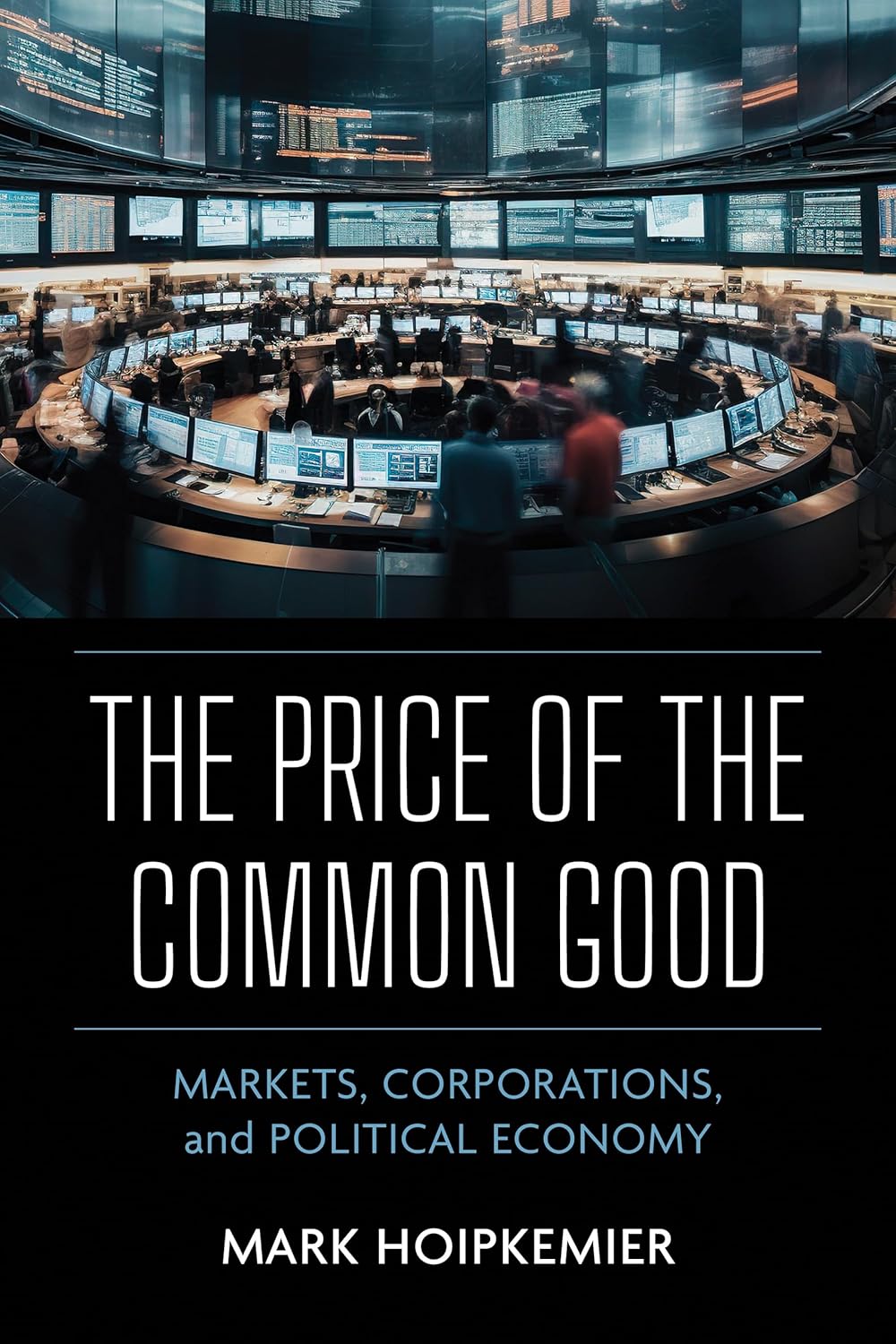
At a conference on business ethics a few years ago, an academic got up to reply to a presentation by a business leader. ‘That’s all very well in practice,’ he said, ‘but what about in theory?’ This book is a careful exploration of how in practice acting together in the service of common goods is more common than we sometimes think, and needs to find its place in any adequate theoretical account of both the firm and the market.
The Chicago View
Hoipkemier has his sights focused in the first part of the book on the narrow conception of the firm as a nexus of contracts between self-interested actors (what he calls the ‘Chicago view’) . Such a view implies the firm is more like a market than a community, and he argues that ‘it’s wrong. It badly mistakes the social and legal reality of the firm’. He goes on to criticise Coase’s account of the firm in terms of cost-saving devices of transacting parties, noting that firms trade on the ‘trust and loyalty and shared culture that arise in human communion’. He argues that the firm’s claims of legitimacy ‘rest on relations of solidarity that demand to be treated as goods or values in themselves’, and that the economic advantages of co-operation ‘can be justly enjoyed only as common achievements … and not as private benefits’. He develops the idea of a firm as a community where membership implies participating in ‘a moral order that is a source of identity, fellowship and character formation’. This allows him to sharply distinguish employees as ‘members’ from shareholders and other stakeholders who have an interest in the firm but are not members of it. A supplier cannot share in the common good of the firm because ‘price centred market exchanges are not a form of common action’. He then interestingly explores the complexity of firms such as Uber where drivers are not employees but yet participate in the common good of the firm and have claims in justice on it.
The Market
The second part of the book is a fascinating exploration of how to understand and think about the market, and where in it – if at all – common goods arise. The author takes us on a journey through Hayek and Polanyi to Genovesi to explore the true nature of markets using a variety of examples, and asks whether and how the political institutions that underpin markets are themselves forms of the common good.
For Hayek the absence of common action or common goods in a market is essential, as it frees participants to focus on quality and price, and price signals in an efficient market contain all the information needed for buyers and sellers. Hoipkemier notes that Hayek’s framework, despite its depth of insight into the power of spontaneous order and the effectiveness of free markets, nonetheless suffers from a deficit in its account of how markets themselves depend on a shared political vision, a broader common project.
Here is where the insights of Polanyi are so relevant, in explaining how the development of markets is inherently political and historically conditioned, and has now escaped the boundaries previous cultures carefully erected. ‘What worried Polanyi, and should worry us still, is that the aspirations of modern liberalism have obscured this civic foundation and allowed the beneficial logic of the invisible hand to metastasise into an all-consuming ideology of the self-regulating market’. Polanyi was profoundly insightful and critical of what he saw as the commodification of people and land, and thought these needed removing from the market altogether, but his analysis was constrained by his assumptions about the limitations of market relationships, and the difficulty he also saw in finding better alternatives.
This is where the humanist vision of market relationships promoted by Genovesi and in recent times by Zamangi and Bruni comes in. Genovesi sees market relationships as ‘a domain of cooperation as well as competition, a sphere of solidarity as well as contract.’ With a different anthropology, market relationships become ‘a site of fraternity where the dominant intention aims at mutual assistance for the sake of a common good rather than interdependent private benefits’. Interestingly, Hoipkemier then speculates on how such a richer commitment in market relationships could be signalled through ‘social co-efficients’ – adjustments to prices to reflect an obligation or gift as well as an entitlement. Attractive as it is, he is also clear about the difficulty of simply generalising this humanistic vision to the wide variety of market relationships from local to global.
The Common Good: Common Action and Common Ends
The governing theme of the whole book is that a grammar of the common good unlocks a more realistic understanding of how human beings participate in both firms and markets. Hoipkemier carefully carves out a specific and limited project here under the title of ‘Aristotelian pluralism’. He is not seeking to settle larger questions about the ultimate common good of society or human flourishing. Rather, by simply recognising that there are patterns of common action to common ends always involved in both firms and markets, he is seeking to expose the limitations of approaches that focus entirely on profits and private gain.
This second half of the book is excellent in drawing out the practical alternatives to the still prevailing narrow orthodoxy of market relationships, and how with a richer anthropology and better grasp of historical context, we are much freer than we sometimes think to re-imagine what market relationships could be, and how they could serve a broader common good. Many enlightened businesses, for instance, describe the shift they seek to make in moving from ‘transactions to relationships’, signifying a desire to broaden their sense of the shared worthwhile endeavour to embrace key suppliers, major customers and other stakeholders. How market relationships develop can be complex and varied, but Hoipkemier’s account helpfully draws out the fact that markets are always culturally and socially conditioned, and that we are not the prisoners of some deterministic Darwinian jungle where the only rule is narrow self-interest.
The Need for Critique
The first part of the book is somewhat less successful. A critique of the Chicago view of the firm is certainly needed, and the retrieval of the idea that common goods are generated and relied on in mainstream business activity is important. But simply saying ‘it’s wrong’ somehow misses the point – it may not be supposed to work in theory but it has been and remains powerful in practice. Some firms, particularly in the financial sector, have in their own terms succeeded: the model is designed so that individuals seeking no more than their own self-interest will behave in a way that enables a firm to maximise its profits. Such firms can and do survive, delivering high profits for investors over time in highly competitive and sometimes toxic working environments. Do they also only succeed through creating and relying on forms of common action that they ignore or deny? To some degree yes, no doubt, but enlightened self-interest in pursuit of private gain is often a prime motivator and plausible explanation for much of what they do.
Rather than claiming ‘it’s wrong’, a different approach would be to posit that there is a choice about how to understand the role of business in society, and how to think about people and what motivates them. The Chicago approach is clear that the role is to maximise profits and the motivation is self-interest. Because we are all malleable, the power of these ideas shapes what results. If we stay in a firm where these ideas are prevalent we are likely to adapt, and the resulting behaviour then reinforces these ideas. But this is a choice, an appeal to a limited view of the firm, and a narrow conception of people.
An alternative choice is that the role of business is to benefit society and that people are more than self-interested. These ideas also shape what a firm can be, and the nature of the social reality that comes into being. It is this alternative view of the firm as a social organisation where the flourishing of people is an intrinsic part of its purpose in society that enables common goods to be both fully recognised and also created. But this also depends on a second dominant idea, namely the operative view within a business of what motivates people. Is it just money, status and power, or are there other desires and motives beyond these, such as meaning, relationality and autonomy? As Sumatra Ghoshal points out in his classic 2005 paper: ‘Bad management theories are destroying good management practices’. Alongside a narrow view of the purpose of the firm, a highly individualistic and distorted view of what it means to be human is also a core problem, and has deeply distorted how business leaders think and act.
A New Anthropology
Hoipkemier brings this anthropological question out very well in the final chapter of the book in the discussion on markets, but it really needed to come at the start. In practice, the strategy and culture of a business are chiefly shaped both by the operative purpose (What is the point of the firm in society?) and also by the quality of relationships it cultivates based on its view of people and its assumptions about what motivates them. Alongside the recognition that common goods arise within firms when there is common action to a shared end, a better anthropology is also needed to recover a more realistic view of the firm as a social organisation where people matter, and want to contribute to a shared, worthwhile endeavour. This double shift in thinking is what can help create a better business, that is also better for society and better for people.
The book is not an easy read, but is carefully crafted and draws on a broad range of sources. In bringing the theory back to practice it would have benefited from references to purpose-led businesses and movements such as the B Corp, which illuminate the shifts in thinking taking place now as many businesses rethink their role in societies facing profound social and environmental challenges.
‘The Price of the Common Good: Markets, Corporations, and Political Economy’ by Mark Hoipkemier was published in 2025 by Notre Dame Press (978-0-268-20897-4). 304pp.

Charles Wookey is an independent consultant and business school teacher. He was a co-founder and CEO of the charity A Blueprint for Better Business, formed after the financial crisis to help create a better society through better business, and now supports its work as a trustee.