
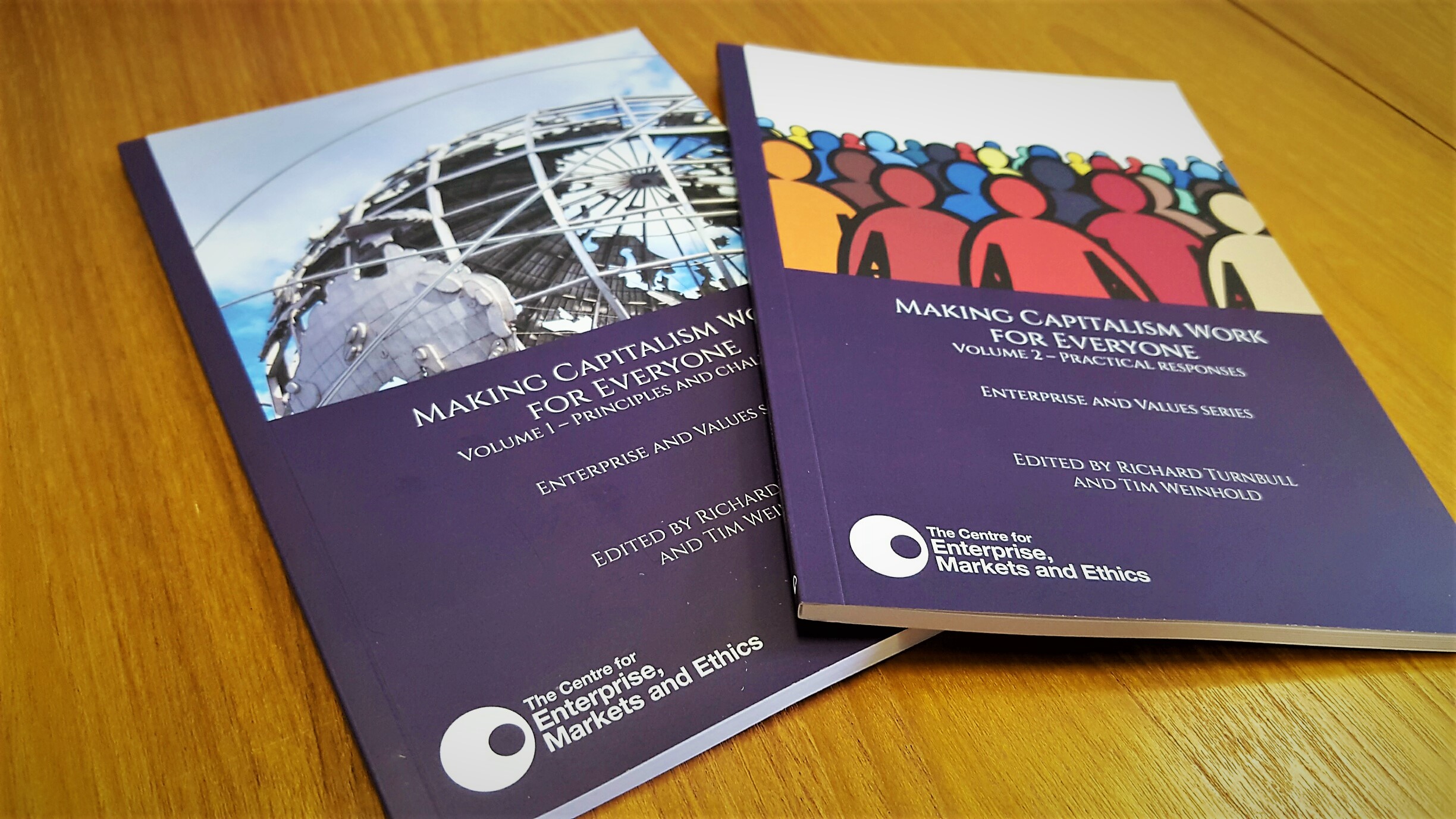
The Centre for Enterprise, Markets and Ethics (CEME) is delighted to announce the publication of Making Capitalism Work for Everyone – Vol. 1 & 2, edited by Richard Turnbull and Tim Weinhold.
Table of Contents
Introduction – Richard Turnbull and Tim Weinhold
Volume One
Chapter 1: Instilling Values in Business – Lord Griffiths of Fforestfach
Chapter 2: Re-imagining Capitalism for the 21st Century – Chris Pinney
Chapter 3: Recovering Moral Purpose in Capitalism – Richard Turnbull
Chapter 4: Capitalism’s Great Divide: The Two Sides of Self-Interest – Tim Weinhold
Chapter 5: The Paradox of Globalisation – Barbara Ridpath
Volume Two
Chapter 1: Creating an Economy of Inclusion – Philip Booth
Chapter 2: Purpose, Practice and Partnership: A Christian Reflection – Jeff Van Duzer
Chapter 3: Benefit Companies – A Pathway to the Future – Rick Alexander and James Perry
Chapter 4: How to Make Finance Serve the Common Good – Cécile Renouard
Introduction
Richard Turnbull and Tim Weinhold
The global economy affects the everyday lives of millions of people. Through the economic system, goods and services are exchanged, jobs created, businesses founded, taxes levied and government services funded. And lives enriched.
However, too often the system seems fixed, either in favour of big corporations, or governments or individual powerful participants. Greed and exploitation seem to replace mutuality and participation. Consequently, extreme inequalities and injustices arise, structures develop that reinforce aspects of a ‘broken system’ and reward is disconnected from long-term performance. As a result, increasingly large numbers of people experience alienation from the economic system whereby not all share in the fruits and benefits of economic success.
Yet this global economic capitalist system, despite all its flaws, has delivered long-term reductions in levels of poverty through jobs, enterprise and freedom. The progress has been phenomenal in terms of global absolute poverty. We cannot simply set aside the principles of economic growth and trade. Similarly, it is unrealistic to think that some sort of utopian society is possible alongside freedom, individual enterprise and personal responsibility. The question, then, is whether the economic system can be structured in such a way that all may benefit, not necessarily equally but certainly fairly.
What would be the characteristics of such a system? Aspiration, enterprise and reward should certainly be prominent, but alongside responsibility and compassion. Similarly, such a system would encompass a business structure that ensures that good work and quality long-term jobs are seen as responsibilities alongside rewarding the providers of risk capital.
We have gathered together a wide range of authors to explore this question of Making Capitalism Work for Everyone. Our contributors do not share exactly the same perspective on economic or other matters. We do not claim ‘to know’ all the answers. We are critical friends of capitalism. We seek neither utopia nor unrealistic redistributive taxation. We want to encourage wealth creation.
However, we do believe that the only effective way to ensure a prosperous economic future is a system in which all have the opportunity to succeed, all are able to participate on fair terms and all can share in just economic rewards. Similarly, we advocate a global economy in which concepts of justice and fairness shape the system. For some of us the motivations will come from a faith perspective, for others, from human values more widely.
In the first volume our contributors reflect on the principles and challenges faced by capitalism. The second volume explores practical approaches.
We are deeply grateful to the Centre for Enterprise, Markets and Ethics, an Oxford-based think tank dedicated to an ethical enterprise economy for sponsoring and publishing this work.
Your two editors are delighted to have formed a close friendship as well as a professional relationship, and we commend these chapters to you.
Volume 1 can be downloaded here and Volume 2 here. Alternatively, you can order paperback copies via contacting CEME’s offices at: office@theceme.org